Unknown's avatar

News of The Future This Week: May 25, 2018

“Amazon is definitely serious about delivering its goods by an autonomous air force.”–Steven Levy


Autonomous cars.  Self-navigating boats.  Self-flying drones. Ah, if only there was a self-writing blog; I would sleep in more often.  The vehicles of the future are all over the news this week.  Let’s catch up.

While you’re reading about all this week’s future-related  news, don’t forget that you can subscribe to Seeking Delphi™ podcasts on iTunes, PlayerFM, or YouTube (audio with slide show) and you can also follow us on Twitter and Facebook 

Future Transport (autonomous, electric, etc.)–According to Bloomberg New Energy Finance, 80% of the world’s urban buses will be electric by 2040.  They also see 28% of all new car sales as electric by 2030.

Soon to be numbered?

–In December 2015, the FAA announced rules to require all flying drones over a certain size to be registered.  Now a new report, also from Bloomberg, suggests that they want to take the regulations a step further, and require license plates.

MIT, ever in the forefront of just about everything and anything autonomous and robotic, has a new invention.  It’s a 3-D printed autonomous boat.  The hope is it might help clear up urban road congestion.  No mention yet of urban waterway congestion, though.


–While we’re talking about MIT, they have a new technology for drones, too.  Its a virtual reality environment to train drones to maneuver through obstacles without putting the real world at risk.

–Mark Zuckerberg and Elon Musk don’t see eye-to-eye on the existential threats of artificial intelligence.  But they do agree on the life-saving potential of A.I. when used to power self-driving cars.

Falcon Heavy launch. Image credit: SpaceX

Space Commerce–Elon Musk aims big; even too big, at times.  But when it comes to space commerce, his SpaceX company is apparently achieving  big.   An analysis by Next Big Future finds that his Falcon 9 and Falcon Heavy rockets may be as much as 15 years ahead of other competitors is the commercial space race, and as much as 10 years ahead of China’s space agency.

Privacy–Facebook is apparently playing a proverbial “both sides against the middle” when it comes to talking privacy with the government.  On the one hand, Mark Zuckerberg promises congress and the EU parliament better safeguards of user data privacy.  On the otherhand, he’s selling facial recognition technology to law enforcement agencies

You can subscribe to Seeking Delphi™ podcasts on iTunes, PlayerFM, or YouTube (audio with slide show) and you can also follow us on Twitter and Facebook 

Unknown's avatar

News of The Future This Week: May 18, 2018

“Happiness is nothing more than good health and a bad memory.”–Albert Schweitzer


Ah memory.  How fleeting and ephemeral–as well as inaccurate–it can be.  Apparently, now, it can be transferred or even implanted falsely.  Westworld may be closer than we think.

While you’re reading about all this week’s future-related  news, don’t forget that you can subscribe to Seeking Delphi™ podcasts on iTunes, PlayerFM, or YouTube (audio with slide show) and you can also follow us on Twitter and Facebook 

Neuroscience/Memory–A team of UCLA scientists claims to have successfully transplanted memory from one snail to another.  I’m not exactly sure what the point is, but I hope the little buggers protected their ATM PIN numbers.

If fake news isn’t bad enough, it appears that UC Berkeley scientists have figured out how to implant fake memories in the human mind using holographic images.   While this could have constructive uses in physical therapy and psychotherapy, it’s also ripe for abuse.

Getting there? Hard. Staying there? Brutal.

Space Colonization–Getting there is less than half the battle.  Maintaining a colony on Mars is replete with challenges, and a new study says having babies maybe one of the biggest ones.

Artificial Intelligence–Demand for artificial intelligence engineers continues to outstrip supply.  In response, Carnegie Mellon has created the first undergraduate program specializing in such.

INTEL has it’s own A.I. plans, at least in the hardware department.  It’s Lohi chip, planned for release next year, will have the equivalent of 100 billion synapses–about the number in the brain of a mouse.

On the road to strong A.I.–machines that can learn anything.

DARPA may be a step closer to the quantum leap that will enable artificial general intelligence.  As advanced as we may think today’s A.I. is, it still only does tasks it is initially designed for.  But DARPA’s L2M initiative is making strides toward developing a system that can adapt to new situations outside their initial programming–a major step towards achieving strong A.I.

SpaceX/Elon Musk–Elon continues to work overtime on ambitious transport projects of all kinds.  The latest is a scheme, combining the joint efforts of SpaceX and Hyperloop, to create a transport system that will enable 1-hour travel time to almost anywhere on earth.

On the road to an ambitious future like the one described above, Musk plans 24 hour turnaround and relaunch of his reusable Falcon 9 rocket, starting in 2019.

You can subscribe to Seeking Delphi™ podcasts on iTunes, PlayerFM, or YouTube (audio with slide show) and you can also follow us on Twitter and Facebook 

Unknown's avatar

Podcast #22: Social Robotics and Symbiotic Autonomous Systems with Roberto Saracco

 “We’re going to become caretakers for the robots. That’s what the next generation of work is going to be.”–Gray Scott


I’m not worried about depressed robots.  But I am worried about masses of people being depressed about robots.  Or any other form of autonomous system, for that matter.  How we use them, how we communicate and interact–and ultimately control them–is critical.  IEEE, ever in the forefront of maintaining standard practices and ethical approaches to technology, is directly in the fray on this one, with its Initiative on Symbiotic Autonomous Systems.  Roberto Saracco, a noted computer scientist and educator from Turin, Italy, is co-director of the initiative;  he joins me for this episode of Seeking Delphi.™


All Seeking Delphi™  podcasts are available on iTunes, PlayerFM, and  YouTube.  You can also follow us on Facebook and on twitter @MarkSackler


Click image for bio


Episode #22:  Social Robotics and Symbiotic Autonomous Systems with Roberto Saracco


YouTube slide show of Seeking Delphi™ podcast episode #22

Related podcast: SXSW 2018 minicast #4, Extreme Bionics and the Future of Human Ability


The Uncanny Valley?


A reminder that this and all Seeking Delphi ™podcasts are available on iTunes, PlayerFM, and  YouTube.  You can also follow us on Facebook and on twitter @MarkSackler

Unknown's avatar

News of The Future This Week: April 19, 2018

“Space in general gave us GPS – that’s not specifically NASA, but its investments in space.”–
Neil DeGrasse Tyson

No more Lost In Space? image credit: http://www.andertoons.com

Maybe NDT is right–NASA didn’t directly give us GPS as in Global Positioning System.  But they are going to directly give us–or at least their astronauts–GPS as in Galactic Positioning System.  What that portends for the ratings for Lost in Space  is beyond the foresight of this blog.  But hey, the plausibility of that series was already next to zero.

While you’re reading about all this week’s future-related  news, don’t forget that you can subscribe to Seeking Delphi™ podcasts on iTunes, PlayerFM, or YouTube (audio with slide show) and you can also follow us on Twitter and Facebook 

Danger Will Robinson, ratings in jeopardy.

NASA/Space–Lost In Space  may now be an obsolete concept.  NASA has unveiled plans for a galactic positioning system that uses x-rays emitted from pulsars.

–The exo-planet exploration baton has been passed from Kepler to TESS.  The newest planet-finding telescope was successfully launched on the back of a SpaceX Falcon 9 rocket.

–As a reminder that technologies, as well as people, are increasingly interconnected, NASA will employ 3D printing to produce over 100 parts of its next generation Orion Space Capsule.  The first manned launch of the vehicle is slated for sometime in the early 2020’s.

Automotive Future–The Verge reports that self-driving vehicles are poised to creat an $800 billion market by 2030 and a staggering $7 trillion by 2050.  Handling the data is key, and Telsa and Waymo are leading the pack.

–Almost on cue with the above, Toyota announced plans to deploy chips, by 2021, that will enable cars to communicate with each other.  The technology has implications for safety in conventional vehicles, and is a flat out necessity for massive autonomous vehicle rollout.

–Even as Uber is still reeling from its first self-driving car fatality in Arizona, competition is heating up on the other side of the globe.  Ola, a major Uber rival in Asia, announced plans to deploy 10,000 electric vehicles within the next year.-

CRISPR/genetic editing–To date, 86 human patients in China have been treated with CRISPR/Cas9 edited cells to help fight cancer and HIV.

–Even as lower regulatory hurdles have been a boon to rapid deployment of human tests in China, Europe has approved its first CRISPR trial for patients with a devastating blood disorder.

Here’s a very brief video with a very basic explanation of what CRISPR does.

Coming Attractions:  The next Seeking Delphi podcast features Roberto Saracco on Social Robotics and the IEEE Initiative On Symbiotic Autonomous Systems.

You can subscribe to Seeking Delphi™ podcasts on iTunes, PlayerFM, or YouTube (audio with slide show) and you can also follow us on Twitter and Facebook 

Unknown's avatar

News of the Future This Week, April 13, 2018

“Suppose you were an idiot, and suppose you were a member of congress; but I repeat myself.”–Mark Twain

Happy Friday the 13th.  With that cheerful note, we go straight to the foibles of the U.S. Congress.  Did you really think that Senators that look and sound more like stuffed dinosaurs than live human beings could really extract anything meaningful from hearings with Mark Zuckerberg?  Really?  I didn’t think so.  My audience is more with it than that.

While you’re reading the future news of the week, don’t forget that  the Seeking Delphi™ podcast is available on iTunesPlayerFM, blubrry , and has a channel on YouTube.  You can also follow us onTwitter and Facebook.

Social Media/Future of Privacy–In a scathing opinion piece on Futurism.com,  Victor Tangermann said that congress is ill-equiped to regulate Facebook.  He says they simply don’t  understand it.

Man or machine?

–Zuckerberg wasn’t exactly stellar in his performance, either.  CNBC’s Jim Cramer speculated that he might not be able to pass a Turing Test.

–Is privacy dead?  Speaking on the Seeking Delphi™ podcast, noted futurist Gray Scott says it has simply become irrelevant. (Scroll all the way down for the YouTube link).

Artificial Intelligence–The military is pursuing AI that mimics the human brain.  But one DARPA scientist thinks that’s the wrong approach.

Biotechnology–It isn’t just for–well, you know–any more.  Viagra might be effective against some cancers.    That’s what I call a pick me up.

NASA/Space–NASA has begun construction and testing on the next Mars rover, due for launch in 2020.

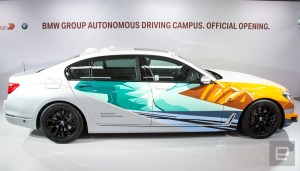
image credit: BMW

Autonomous Driving-Whatever the problems and perceptions, self-driving cars are not going away.  BMW became the latest major player, launching an autonomous vehicle research center.

Automation/Future of Work–What’s billed as the world’s first “unmanned” bank has opened in Shanghai.  It’s complete with a robot bank manager.


A reminder that the Seeking Delphi™ podcast is available on iTunesPlayerFM, blubrry , and has a channel on YouTube.  You can also follow us onTwitter and Facebook.

Unknown's avatar

Podcast #21: The Future of Privacy In The Digital Age, with Gray Scott

 “We are losing privacy at an alarming rate–we have none left.”–John McAfee

Privacy is becoming irrelevant.”–Gray Scott


Is privacy dead?  The answer may be more indifferent than you suspect.  Gray Scott says it’s becoming irrelevant.  People and politicians may squawk, but if you look at their behavior, it looks as if they just don’t really care.  It seems we’d rather have free content–even at the cost of privacy–than pay even nominal amounts to access online materials.  In this wide ranging interview, conducted just hours before Mark Zuckerberg’s senate testimony in the wake of the Cambridge Analytica data breach, Gray provides us with his nuanced view of the state of privacy, both present and future.

A reminder that this and all Seeking Delphi™  podcasts are available on iTunes, PlayerFM, and  YouTube.  You can also follow us on Facebook and on twitter @MarkSackler


Podcast episode #21: The Future of Privacy In The Digital Age, with Gray Scott

YouTube slide show of Podcast #21: The Future of Privacy with Gray Scott

A reminder that this and all Seeking Delphi ™podcasts are available on iTunes, PlayerFM, and  YouTube.  You can also follow us on Facebook and on twitter @MarkSackler