I’m not worried about depressed robots. But I am worried about masses of people being depressed about robots. Or any other form of autonomous system, for that matter. How we use them, how we communicate and interact–and ultimately control them–is critical. IEEE, ever in the forefront of maintaining standard practices and ethical approaches to technology, is directly in the fray on this one, with its Initiative on Symbiotic Autonomous Systems. Roberto Saracco, a noted computer scientist and educator from Turin, Italy, is co-director of the initiative; he joins me for this episode of Seeking Delphi.™
Is privacy dead? The answer may be more indifferent than you suspect. Gray Scott says it’s becoming irrelevant. People and politicians may squawk, but if you look at their behavior, it looks as if they just don’t really care. It seems we’d rather have free content–even at the cost of privacy–than pay even nominal amounts to access online materials. In this wide ranging interview, conducted just hours before Mark Zuckerberg’s senate testimony in the wake of the Cambridge Analytica data breach, Gray provides us with his nuanced view of the state of privacy, both present and future.
” The only true disability is a crushed spirit.”–Aimee Mullins
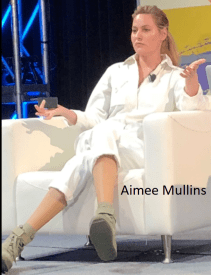
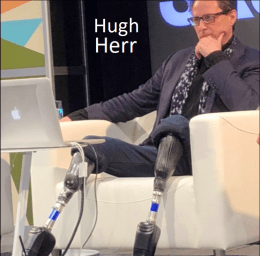
In this final instalment from the first Seeking Delphi™ visit to SXSW, we hear from two of the most remarkable individuals I have ever had the pleasure of meeting.
The session, entitled Extreme Bionics: The Future of Human Ability, delved 100 years into the past, covering the history of prosthetic devices from the crude low-tech devices built for World War I amputees, through to the increasingly high tech devices of today. Furthermore, it looked to a future that might bridge the final gap to neurological embodyment of artificial limbs, and various technologies that will enhance natural biological human abilities along with prosthetic devices.
Aimee Mullins was born without shin bones and lost both of her legs below the knee at the age of one. She has hardly let that stop her–she was a paralympian and is a model and actress. Most notably, she had a recurring role in season two of the hit Netflix series, Stranger Things.
Hugh Herr lost both of legs below the knee at age 18 to frostbite suffered in a mountain climbing mishap. He is an associate professor and head of the biomechatronics group at MIT’s Media Lab.
In keeping with the future theme of Seeking Delphi™ I asked both of them to imagine the future of these technologies. This panel was part of the IEEE Tech for Humanity series at SXSW 2018. Acknowlegements to them, and to Interprose, for arranging these interviews.
If David Duchovney is right–and I for one agree with him–then Fermi and his paradox certainly become relevent. But it hardly proves that extraterrestrials don’t exist. It just proves we haven’t been able to confirm any signals or communication. What hampers us from doing so? The vastness of the universe? Our relatively inferior technology? Maybe they are hiding, as in Cixin Liu’s chilling novel The Dark Forrest? These are all possiblities, true. But in a strange ocurrance of the law of unintended consequences, the biggest current hindernece to finding E.T. could be bitcoin mining.
While you’re reading about all this week’s future-related news, don’t forget that you can subscribe to Seeking Delphi™ podcasts on iTunes, PlayerFM, or YouTube(audio with slide show) and you can also follow us on Twitter and Facebook
SETI/Cryptocurrencies–This heading might look like an oxymoron. But in a bizarre turn of events, the cornering of the GPU market by Bitcoin and other cryptocurrency mining has created a shortage that is hitting the video game market, and even the search for extraterrestrial intelligence.
Artificial Intelligence/Singularity–In an interview with Futurism.com, the father of artificial intelligence says that the singularity is 30 years away.
You’ve heard it all, and lately you’re hearing it more. The singularity is near. Robots are going to take our jobs. Robots are going to take over altogether. Robots are even going to take over our sex lives. Yadda yadda yadda.
I’m not saying it won’t happen; I just think it’s farther away than the impression most people are getting from all the news. What’s here right now is genetic editing, and with it, the possibility of directing human evolution. The very real and very near possibility of changing what it means to be human. Read all the artificial intelligence and future of work articles–yes. But listen to what Elizabeth Parrish has to say about modifying the human genome to reverse aging and to keep up–cognitively and physically–with robots.
Seeking Delphi™ will be on vacation next week. Enjoy the peace and quiet.
—Here’s the latest take on the robot job apocalypse. A new report suggests the UK will lose one in 12 jobs to robots and automation by 2030. That’s less then some forecasts, but still enough to be a bother.
Self-Driving vehicles–Have we been hearing altogether too much about autonomous vehicle development, lately. Satirical web site, The Onion, seems to think so. The released the image below with headline Tesla Debuts Carless Driver.
Image Credit: The Onion
Thanks for visiting and reading. See you in two weeks.
While you’re reading about all this week’s future-related news, don’t forget that you can subscribe to Seeking Delphi™ podcasts on iTunes, PlayerFM, or YouTube(audio with slide show) and you can also follow us on Twitter and Facebook
“My mentality is that of a samurai. I would rather commit seppuku than fail.”–Elon Musk
“The best way to predict the future is to invent it.”–Alan Kay
Technology was everywhere in 2017. And everywhere technology went, Elon Musk was sure to lead. Perhaps we should paraphrase Alan Kay. The best way to predict the future, is to watch Elon. If anybody is inventing it, it’s him. Tesla, Solar City, SpaceX, Neuralink, Hyperloop. If it involved renewable energy, autonomous vehicles, space commerce, transhumanism, or warnings about artificial intelligence (lot’s of warnings), it probably involved Elon.
With that, I name Elon Musk, in total, our first Future Story of The Year, for 2017. Here’s a very brief history of his year, along with some of the other top stories from 2017.
While you’re reading about it all, don’t forget that you can subscribe to Seeking Delphi™ podcasts on iTunes or PlayerFM, and you can also follow us on Twitter and Facebook
So…how many new technology ventures will he create in 2018, as he continues to invent the future? I’d put the over/under at 2 1/2.
Other top stories of the Year.
Artificial intelligence, CRISPR/Cas9 gene editing, self-driving cars, Bitcoin and blockchain, reversing aging and the future of work, were all frequently in the news in 2017. Somewhat less visible were stories about laboratory grown meat, reversing aging, hypersonic weapons, 3D printing and advanced drone technology. Here are few top story lists from other sources.
Seeking Delphi™ finished the year with a podcast interview with SENS foundation,s chief science officer, Aubrey de Grey, on ending aging.
Happy New Year, all. 2018 figures to be quite a ride.
Coming Attractions–2018 will kick off with an interview with Bioviva CEO Elizabeth Parrish, the first person to edit parts of her own genome to reverse aging.








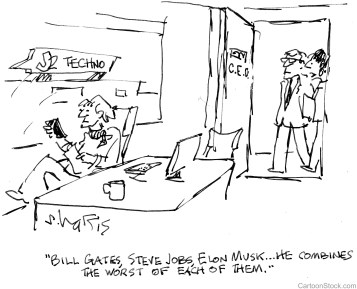 Technology was everywhere in 2017. And everywhere technology went, Elon Musk was sure to lead. Perhaps we should paraphrase Alan Kay. The best way to predict the future, is to watch Elon. If anybody is inventing it, it’s him. Tesla, Solar City, SpaceX, Neuralink, Hyperloop. If it involved renewable energy, autonomous vehicles, space commerce, transhumanism, or warnings about artificial intelligence (lot’s of warnings), it probably involved Elon.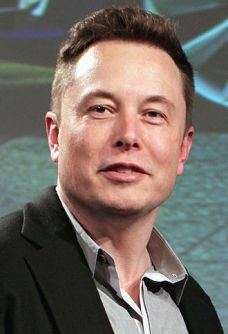
 Seeking Delphi™