Unknown's avatar

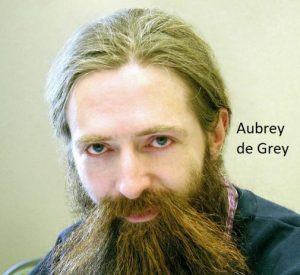
Podcast #19: Ending Aging, with Aubrey de Grey

“Aging is mostly the failure to repair.”–Gregory Benford

One man who agrees wholeheartedly with Gregory Benford is Aubrey de Grey.  He’s the author of Ending Aging, and chief science officer of the SENS Foundation, a 501-(c)(3) non-profit dedicated to researching the reversal of human aging.  His approach focuses on 7 areas of cellular and molecular damage, the repair of which he believes to be the keys to effective rejuvenation therapy. He joins me in this episode of Seeking Delphi™ for a lively discussion on the present state of the anti-aging art.

Links to relevant stories appear after the audio file and embedded YouTube video below.  A reminder that this and all Seeking Delphi ™podcasts are available on iTunes, PlayerFM, and has a channel on YouTube.  You can also follow us on Facebook

Follow me on twitter @MarkSackler


Episode #19, Ending Aging With Aubrey de Grey

YouTube slide show of Episode #19


Relevant links

Aubrey de Grey wikipedia bio

SENS Foundation

Elizabeth Parrish self-tests Bioviva gene therapy

Brian Hanley’s bold experiment

George Church’s ambitious plans

Laura Deming’s Longevity Fund

Information injected into monkey brains

Subscribe to Seeking Delphi™ on iTunes 

Subscribe to Seeking Delphi™ on PlayerFM

Subscribe on YouTube

Follow Seeking Delphi™ on Facebook @SeekingDelphi

Follow me on twitter @MarkSackler

Unknown's avatar

The Future This Week: October 31, 2017

“Aging is mostly the failure to repair”– Gregory Benford

“Age is inevitable; aging isn’t”–Marv Levy

Even as lifestyle issues like smoking, obesity, distracted driving and drug overdoses have of late limited life expectancy gains in the west, there continue to be breakthroughs in anti-aging research at breathtaking pace.  At some point–maybe soon–we may experience a period of anti-aging therapy deployment such that average life expectancy increases by one or more years every year. How long will we live, then?  And the bigger question is: what will be the implications for civilization and the earth as a whole?

 While you’re reading about all this week’s future-related  news, don’t forget that you can subscribe to Seeking Delphi™ podcasts on iTunes or PlayerFM, and you can also follow us on Twitter and Facebook 

Anti-aging/Longevity research–Virtual biotech company, Youthereum, believes they can extend healthy human lifespan by 30% using epigenetics.  The idea of such an approach as  has been around for decades; they believe they are in striking range of achieving it.  The unconventional part of the plan is not the science, it’s financing the research, which they hope to accomplish through an ICO (Initial Coin Offering) of a new cryptocurrency.

Two University of Arizona scientists have published a paper on the mathematics of aging, purporting to prove that immortality is impossible.  That sounds suspiciously like the scientist who published a paper supposedly proving that space travel was impossible, just a few months before the launch of the first Sputnik.

Food– Food distribution giant, Cargill, Inc., has joined the likes of Bill Gates and Richard Branson with investments in Memphis Meats.  The San Francisco-based (not Tennessee) company says its products–lab grown beef, chicken and duck–will be in stores by 2021 and will eventually cost as little as $1 a pound.  The products use real animal cells, but obviate the need to raise and kill live animals.

Space Launch and Propulsion–Positron Dynamics is projecting the potential launch of an anti-matter propelled cubesat by as early as sometime next year.  It further forecasts that a Mars-bound anti-matter powered rocket could be launched by the 2030’s.

–Meanwhile, Elon Musk’s SpaceX continues to make progress towards lowering the cost of space launches.  This past week, it conducted its fifteenth consecutive successful launch and first stage landing of the reusable Falcon 9 rocket.

China/Economic Development–The New York Times reports that Chinese president Xi Jinping wants to fully eliminate poverty in his country by 2020.   It’s all part of the larger Xi plan which outlines many of the country’s goals, including those in healthcare, AI, and the sharing economy, through 2050.

A reminder that the Seeking Delphi™ podcast is available on iTunesPlayerFM, blubrry , and has a channel on YouTube.  You can also follow us on Facebook.

Unknown's avatar

The Future This Week: September 26, 2017

“By far the greatest danger of Artificial Intelligence is that people conclude too early that they understand it.” –Eliezer Yudkowsky

Just two weeks after the first Emotion AI Summit–an event that might not have been possible even a year ago–there is an explosion of news around artificial intelligence.  The sum of the stories might best be described by the subtitle of my other blog: ridiculous and sublime.  As sure as there is the potential to use new technology for both good and evil, there is also the likelihood that someone will use it, well, to be just plain silly.  So here is the good, the bad, and the positively daft.   And be sure to check out the Seeking Delphi™ Podcast on the  Emotion AI Summit, if you missed it last week.

Artificial Intelligence/Robotics–A prominent Silicon Valley CEO has made a very direct prediction regarding the future progress of AI.  Jim Breyer, CEO of Breyer Capital, said in a CNBC interview that artificial intelligence will be able to learn on a par with humans by 2050.

–Current specific AI uses for security-related applications are on the rise.  At least three of these uses came to light in the last few days.   These include an effort in  Brazil to monitor electric power use and detect theft or meter fraud,  the possible detection and prevention of power grid disruptions by the U.S. Department of Energy, and a news scanning bot that collects data on police shooting nationwide. 

–As for those silly uses of AI, consider a British company that has brought to market a sex robot that tells jokes–for a sticker shock inducing $4500.00, and  the Japanese (who else?) have invented a robodog that can sniff your feet and tell you if they smell bad. (Doesn’t everything smell good to a dog?)

Meet Samantha, the joke-telling sexbot.

–Almost on cue for the above story, researchers at Columbia Engineering Machine Labs have revealed that they have created a 3D printed silicon robot muscle that closely resembles real human muscles, but is several times stronger.

-Vladimir Putin has more to say about artificial intelligence.  A few weeks back he said that whomever controls artificial intelligence will control the world.  Now he’s warning–get this–artificially intelligent robots might eat us.  Sorry for the spoiler alert, but in Will Mitchell’s sci-fi novel, Creationsthey sort of do.

A new report by the World Economic Forum projects the global market for artificial intelligence will grow at a compound rate of over %17, to annual value of US$14 Billion by 2023. It also spews the now commonplace doom and gloom about job displacement.

An editorial in Wired magazine suggests that an ethical watchdog for artificial intelligence is desperately needed.  Actually, IEEE is working on one, and the head of the effort will be on an upcoming edition of the Seeking Delphi™ podcast.  (See coming attractions, below)

Biotech/TranshumanismThe journal Science has reported that neuroscientists in Lyon, France have partially restored consciousness to a man who had been in a vegetative state for the past 15 years.  Can that sci-fi deep state hibernation be far behind?

Coming Attractions–Up next on the Seeking Delphi™ podcast will be futurist Dr. Linda Groff on her upcoming book on options for future human evolution.  Also keep an eye out for the ethics of artificial intelligence, with Heartificial Intelligence author John C. Havens.

A reminder that the Seeking Delphi™ podcast is available on iTunesPlayerFM, blubrry , and has a channel on YouTube.  You can also follow us on Facebook.

Unknown's avatar

The Future This Week: August 28, 2017

 “Millions long for immortality who don’t know what to do with themselves on a rainy Sunday afternoon.”–Susan Ertz

Like it or not, anti-aging reasearch–the quest to slow, stop, or even reverse the aging process, has gone mainstream.  Several serious projects have been funded, animal and even human trials of age retarding pharmaceuticals have begun.  It isn’t just on the fringe, anymore.

Aging/rejuvenation therapy research– The Longevity Fund just completed its second round of capital raising, to the tune of $22 million US dollars.  It aims to invest in all manner of enterprises looking to boost human lifespan.  And it was founded by 23-year-old Laura Deming–she is certainly thinking ahead.

Electric Vehicles-The latest report on Tesla’s proposed new all-electric semi-truck, is that it will have a range of 200-300 miles.  They also assert that use of it’s auto-pilot feature could reduce crashes by up to 40%, though with the limited range it is not likely to make a significant dent (pardon the expression) in that rate any time soon.  The truck has been promised to be available as soon as next month.

Airline Travel–Qantas has set in motion a very tentative plan to launch the world’s longest regularly scheduled airline route.  They hope to begin service between Sydney and London by 2022.  There’s just one problem.  The key word is tentative–there is no current model airliner capable of a flying that far without refueling.  Qantas has thrown down the challenge to Boeing, Airbus, and others: develop one.

Flying Taxis–Speaking of aircraft manufacturer’s, Airbus intends to launch an urban, autonomous flying taxi service, and do it soon.  Worry no more about traffic jams on the ground–and let the FAA and other air transportation regulators worry about traffic jams in the sky.  Boeing says they will be flying by the end of this year.

Machine-brain Interface–The journal Science reports that engineers at Northeaster University have published a breakthrough study on miniaturized antennas.  The devices are 100-times smaller than any previously possible, and may be used to enable  implants in the brain and micro–medical devices, not to mention tiny consumer electronics.

Creative Artificial Intelligence–The world’s first music album,  composed and arranged by AI in collaboration with a human artist has been released by Amper Music.  The A.I. does almost everything except perform. That is left to popular internet artist Taryn Southern, backed by professional studio musicians. Southern wrote the lyrics and the vocal melody. See the YouTube video below.

Coming Attractions–The next Seeking Delphi™ podcast will feature an interview with Bloomlife CEO and co-founder Eric Dy.  The company’s health monitoring device that keeps tabs, simultaneously, on pregnant women and their unborn babies,  recently won an impressive innovation contest.

A reminder that the Seeking Delphi™ podcast is available on iTunesPlayerFM, blubrry , and has a channel on YouTube.  You can also follow us on Facebook.

Unknown's avatar

The Future This Week: August 14, 2017

“Life isn’t a tiptoe through the tulips.”–Shannon Hoon

“When tulip mania dies down, all that remains are pretty flowers.”–Adam Cohen

I understand the value of cryptocurrency–I think.  But the valuation? Forget it.  Investors’ lives certainly won’t be a tiptoe through the tulips when and if the Bitcoin bubble bursts.  But I’ll still love hearing Tiny Tim sing about it.  And yes, tulips are still pretty flowers.

Bitcoin/Cryptocurrency–The price of a single Bitcoin topped $4,000 for the first time.  Is cryptocurrency the future of our economy?  I have my doubts.   And if you are looking for a way to short it, that makes two of us.

Semi-conductors/material science--With transistor miniaturization in silicon-based microchips rapidly reaching its physical limit,  Moore’s law could also be coming to an end.  But researchers at Stanford University have identified two semi-conductors that could extend the limits of silicon-based miniaturization by augmenting its properties.

Does “too cute to eat” also mean, “too cute to accept an organ transplant from?’

Biotech/gene editing–A group led by Dr. George Church, of Harvard University, has succeeded in using gene-editing to make piglets more suitable for growing replacement human organs.   Dr. Church believes that the first pig-to-human organ transplants may be as close as two years away.

Robotics/Artificial Intelligence–The premiere issue of Age of Robots has hit the digital newsstands.  My article, Self Replicating MachinesScience Fiction vs. Science Fact, appears, along with stories on artificial intelligence, medical robots,  machine consciousness, and more.

   Quantum Reality–A future after death? The notion of life after death has always been the exclusive realm of the spiritual/religious world–until now, that is.  Physicist and author Roger Penrose,  along with some others with impressive scientific credentials, now believe that information stored in our brains in a quantum state may live on, along with our consciousness, after we die.  This report, on the Galaxy Today web page, hints at any number of ideas which I have expounded on in my other blog,  The Millennium Conjectures.

A reminder that the Seeking Delphi™ podcast is available on iTunesPlayerFM, blubrry and , and has a channel on YouTube.  You can also follow us on Facebook.

Unknown's avatar

The Future This Week: April 23, 2017

“Getting information off the internet is like taking a drink from a fire hydrant.”–Mitchell Kapor

This week, I feel like I’m trying to take a drink from an open fire hydrant.  There’s simply a flood of news from all the usual suspects: A.I., robotics, transhumanism, flying cars, AR, VR, gene editing.   Oh, don’t forget Elon Musk–he’s perpetually in the news, though he might have been upstaged by Neil DeGrasse Tyson this week.

Elon Musk–Full page ads–described by CNN as anti-Elon Musk–ran in the Sunday editions of several major news papers including the New York Times and Washington Post.  They were run by a silicon valley investor who is critical of Musk’s participation in the Trump business advisory council.

Neil DeGrasse Tyson–Timed to coincide with the national march for science day, Tyson released a statement warning that America faces pending collapse if it abandons the rational, empirical world of science. (video below)


Facebook F8 conference–Speaking at Facebook’s annual F8 conference, Michael Abrash, chief science officer of Oculus Research, said that AR glasses will be hotter than smartphones in five years.   Maybe he’s looking at the digital world through rose-colored glasses?

Meanwhile, at the same conference, Facebook executive Regina Dugan announced an ambitious project to enable direct brain to computer typing at 100 words per minute.  She asserted that, unlike Elon Musk’s neural lace, this will be a non-invasive process.  I can’t wait to be able to think-type “the quick brown fox jumped over the lazy neuron.”

Genetic Editing/CRISPR–Feng Zhang, one of the co-inventors of the breakthrough CRISPR Cas/9 gene editing technique, has a new acronym for you biotech fans.   SHERLOCK.  It employs a relative of the Cas/9 protein designated Cas/13a and according to a paper published by Zhang and others in the journal Science, will be useful for rapid and cheap diagnosis of genetic disorders.

MiRo, the robotic dog

Robotics–The Daily Mail reported that researchers at the University of Sheffield, in England, have created a robotic dog that is designed to be a responsive companion for the isolated elderly.  The article, along with a video, is available here.

Flying Cars–German company Lilium Aviation previewed its electric-powered vertical take-off and landing (VTOL) vehicle. Essentially, a flying car. (video below)

A reminder that the Seeking Delphi™ podcast is available on iTunes, and has a channel on YouTube.  You can also follow us on Facebook.