Unknown's avatar

The Future This Week, April 2, 2017: Robot Job Apocalypse?

“The danger of the past was that men became slaves. The danger of the future is that men may become robots.”–Erich Fromm

You’re fired!

Today’s lead story brings to mind a classic gag from Woody Allen’s early stand-up comic days.  He told the story of how his father came home from work one day to report that he had been laid off from his factory job; he was replaced by a 50-dollar part on the assembly line.  The sad thing was, his mother immediately ran out and bought one of those parts.

The notion that a manufacturing plant  could be comprised of 3D printers run and maintained by robots is mind boggling.  So who maintains the maintenance robots?  Maintenance maintenance robots?  And who maintains the maintenance maintenance robots….?

3D Printing/Automation–

Yes, Voodoo manufacturing has created the world’s first robot-run 3D printing plant.   It allows the humans to concentrate on the creative work while the robots do the menial work, 24/7.  So what happens when A.I. starts doing the creative work?

Writing in the futures blog on Futurizon,  Ian Pearson, Ph.D., takes the position that A.I. will actually create jobs, not take them.  Dr. Pearson will be my guest on the Seeking Delphi podcast, the week of April 10.


Miranda. Maybe this is where all those lost socks went?

Space/NASA–NASA astronauts made a big booboo when they lost an important part of the International Space Station during a spacewalk earlier this week.   One of four pieces of cloth shielding designed to protect the station from impacts by small bits of orbiting  space junk, broke free and floated away.  The astronauts were able to make the other three pieces make do.  That’s a good thing.  For all we know, the interplanetary lost and found could be on Miranda.

Next Big Future reports that there is a push within the Chinese government to triple spending on space science over the next several years.  It’s still far less than NASA spends, though. Projections through the year 2030 are provided.

Digital Media–Business Insider issued a report, along with a free slide presentation, on the future of TV and the digital media that is rapidly replacing it.  Most notable is a forecast that fully 75% of all mobile data will be video by 2022.  My guest next week will be filmmaker and author Steven Katz  to discuss the future of  cinema and the digital video entertainment it is competing with.

Cargo drone or killer whale?

Aviation/Drones– An automated  amphibious cargo drones the size of a Boeing 777 could take to the skies by 2020.  Daily Mail reports that the California company building them is about 70% complete on the first test model.  The final production model will have a carrying capacity of 200,000 pounds.

Biotech/Anti-Aging–PureTech Health has licensed a possible anti-aging compound from NovartisMIT Technology Review reported that Boston-based startup company .  The drug, everolimus has been shown in clinical trials to increase effectiveness of flu vaccines in elderly patients, suggesting that it effectively makes immune systems younger.  The substance is related to rapamycin, which has previously been shown to increase average life span in mice by as much as 25%.

A reminder that the Seeking Delphi™ podcast is available on iTunes, and has a channel on YouTube.  You can also follow us on Facebook.

Unknown's avatar

Podcast #9, Ethics and Emerging Technologies

All attempts to adapt our ethical code to our situation in the technological age have failed.–Max Born 

When thinking about the future of technology, many envision one extreme or the other.  Apocalyptic collapse, or Utopian delight.  There is a broad in between, however, filled with ethical as well as existential conundrums.  In this episode of Seeking Delphi, I talk with James J. Hughes, director of The Institute for Ethics and Emerging Technologies about a wide range of issues.  These include not just the ethics of if, how, and when to proceed with certain technologies, but the ethics of public policy in dealing with the potentially disruptive social and economic changes they trigger.  The future is not black and white–in case you hadn’t noticed–but infinite shades of gray. It’s also clouded by the rise of the right and the Trump administration.

Links to relevant stories appear after the audio file and embedded YouTube video below.  A reminder that Seeking Delphi is available on iTunes, and has a channel on YouTube.  You can also follow us on Facebook.


Episode #9: Ethics and Emerging Technology


(YouTube slideshow)


James Hughes bio

Harvard scientists to launch ambitious geoengineering experiment

World Future Society 2017  conference in Edinburgh, Scotland, Oct 12-14 (details soon).

Elon Musk launches venture to link brains directly to computers

Subscribe to Seeking Delphi on iTunes 

Subscribe on YouTube

Follow Seeking Delphi on Facebook @SeekingDelphi

Follow me on twitter @MarkSackler

Unknown's avatar

The Future This Week, March 26, 2017–Live Forever, or Just Live Better?

“I think science has begun to demonstrate that aging is a disease. If it is, it can be cured.”–Tom Robbins
“I’m not afraid of death.  I just don’t want to be there when it happens.”–Woody Allen

Our time is limited. Or is it?

It seems as if many of the biggest players in science and digital industry are obsessed with slowing, stopping, or even reversing aging.  New stories appear every day, it seems.  And of course, David Wood’s comprehensive study of the issue, The Abolition of Aging, was the subject of the first two episodes of Seeking Delphi.  But an editorial in Wired Magazine suggests that the moguls of silicon valley are trying to solve the wrong problem. It asserts that they should be working to improve the quality of life, not the quantity.  There are good arguments both ways–reversing aging could greatly improve human health and cut costs drastically–the lions share of healthcare spending treats the diseases of aging.  What do you think?   The big stories this week:

Biotechnology/Aging Research–

  • A pair of breakthroughs, one from The University Ulm in Germany, the other from the University of Ulster in the UK, suggest means of using young blood cells to provide anti-aging properties.  The two studies are summarized in this article by Next Big Future.


  • Writing in Wired Magazine, Emily Dreyfus argued that huge investments in anti-aging  research by major silicon valley entrepreneurs is barking up the wrong biological tree.  She thinks they should be investing in better quality of life rather than increased quantity.

Autonomous Vehicles–

Social Robotics–

  • The world’s first social media robodog has been created by Jason Buzi.  Now we just need a robot veterinarian to take care of it. (See below).


A reminder that the Seeking Delphi™ podcast is available on iTunes, and has a channel on YouTube.  You can also follow us on Facebook.


Unknown's avatar

Podcast #8: Inventing The Local Future

“The best way to predict your future is to create it.”–Abraham Lincoln

“Think globally, act locally.”–Variously attributed

If you’ve never heard the phrase, “think globally, act locally,”  you’ve probably been living under a rock.  It’s origin is murky, but the concept is best attributed to Scottish town planner Patrick Geddes, and his 1915 book, Cities in Evolution.   100 years later,  Neil Richardson and Rick Smyre have written the 21st century blueprint for Communities of the Future, in their 2016 volume, Preparing for a World That Doesn’t Exist–Yet.  In my Seeking Delphi podcast interview with Neil Richardson,  we discuss many of the bold ideas in the book, including the authors’ call for enabling what they call a “second enlightenment.”   We also discuss three key points in the book–terms the authors coined–master capacity builder,  polycentric democracy and creative molecular economy.  Previous podcast episodes of Seeking Delphi have showcased technological quantum leaps that have the potential to cause radical upheaval of civilization.  Authors Richardson and Smyre point the way for small to medium organizations and communities to deal with it–to embrace, use, and grow with it.    A means to invent the local future.

Links to relevant stories and organizations appear after the audio file and embedded YouTube video below.  A reminder that Seeking Delphi is available on iTunes, and has a channel on YouTube.  You can also follow us on Facebook.  The YouTube video of Robot’s Delight is embedded below.


Episode #8: Inventing The Local Future 28:50


(YouTube slideshow)

Preparing For A World That Doesn’t Exist–Yet, on Amazon and Barnes & Noble

Emergent Action

Communities of The Future

European biocomputing project

India, China and Japan to increase coal usage through the 2020’s.

Facebook anti-suicide project


Subscribe to Seeking Delphi on iTunes 

Subscribe on YouTube

Follow Seeking Delphi on Facebook @SeekingDelphi

Follow me on twitter @MarkSackler

Unknown's avatar

The Future This Week, March 19, 2017

“There are nights when the wolves are silent and only the moon howls.”–George Carlin

The moon, and space exploration in general, continued to make news this week.  It seems the moon is just howling for some company.  Here’s what’s been happening during the current lunar phase.

Space Exploration–


Additive Manufacturing/3D printing–

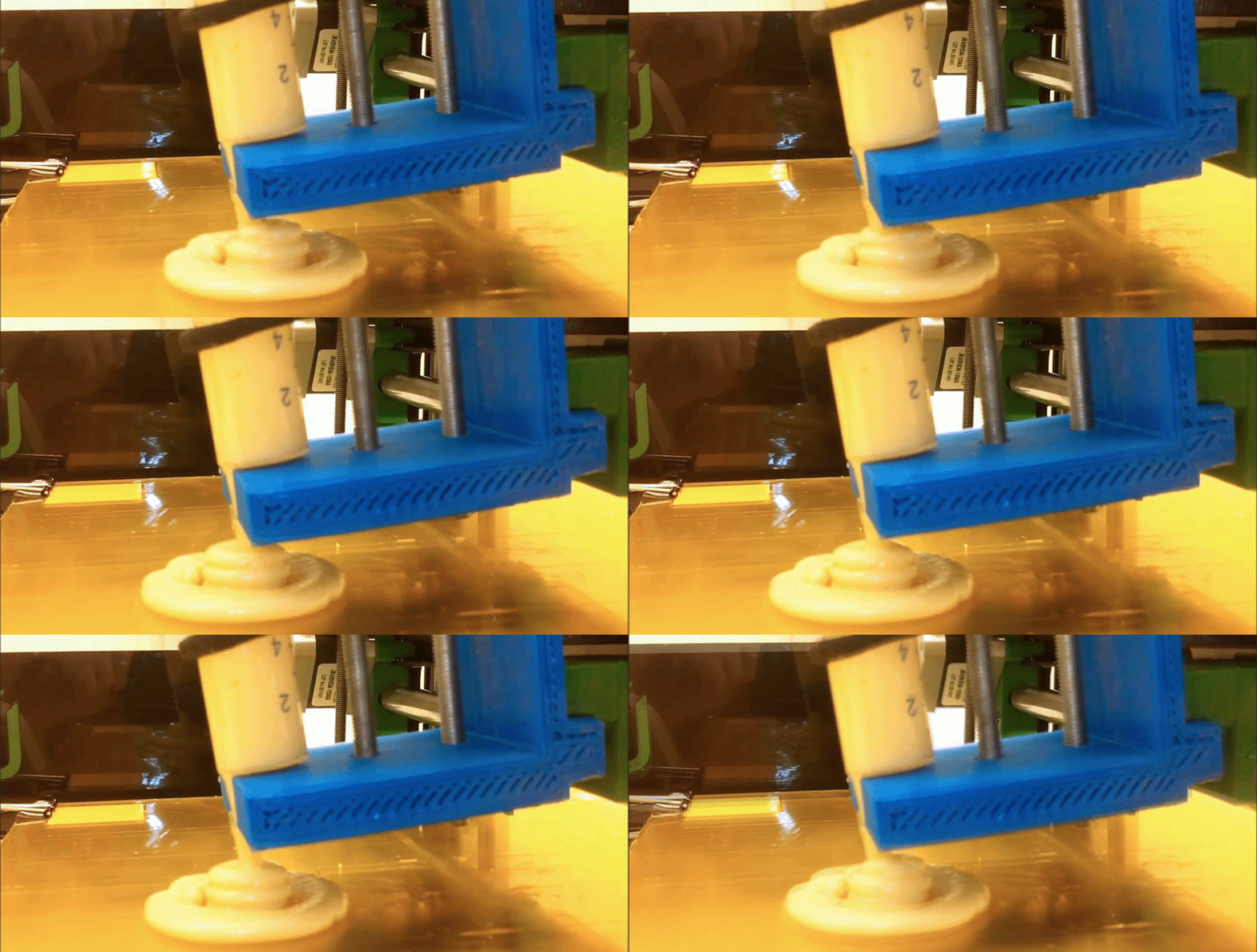
  • In an interview on the Seeking Delphi podcast, Dr. Paul Tinari made a variety of bold statements regarding the future of 3D printing for everything from food to cars, homes, battleships, and even human bodies.  (YouTube link available at the bottom of this post.)


Biotech–

  • Gene editing startup eGenisis raised $38 million dollars in venture capital funding for its process to use CRISPR/Cas9 gene editing to grow pig organs for human implantation.  The company was co-founded by Harvard genetics guru, Dr. George Church and 30-year old Dr. Luhan Yang.


YouTube slide show: Podcast #7, 3D printing with guest Dr. Paul Tinari.  Also available on iTunes.

A reminder that the Seeking Delphi™ podcast is available on iTunes, and has a channel on YouTube.  You can also follow us on Facebook.

Unknown's avatar

Podcast #7, The 3D Printing Explosion: Cars, Homes, Even Human Bodies!

“Whatever good things we build end up building us.”– Jim Rohn

I can’t say for sure if the quote above was intended literally, but it is now becoming literally true.  The applications of additive manufacturing–better known as 3D printing–are expanding to include food, body parts, cars, and even entire buildings.  In this episode of the Seeking Delphi™  podcast, I talk with one of the gurus of this technology, Dr. Paul Tinari, of JOOM3D.com .  He’s working on a project the scope of which would have been unimaginable just a few years ago.

Links to relevant stories appear after the audio file and embedded YouTube video below.  A reminder that Seeking Delphi is available on iTunes, and has a channel on YouTube.  You can also follow us on Facebook.


Episode #7, Additive Manufacturing: We Are What We Print 21:07


(YouTube slideshow)


Paul Tinari Bio

Russian space agency recruiting cosmonauts for 2031 lunar landing mission

Ray Kurzweil revises his singularity forecast to 2029

The U.S. military seeks to “understand” its autonomous machines

Subscribe to Seeking Delphi on iTunes 

Subscribe on YouTube

Follow Seeking Delphi on Facebook @SeekingDelphi

Follow me on twitter @MarkSackler