Unknown's avatar

The Future This Week: November 28, 2017

“Always make the audience suffer as much as possible.”–Alfred Hitchcock

It seems movie theater owners are taking Hitchcock quite literally.  At our first break from home binge watching in almost a year, my wife and I went to a local cinema. We arrived right on the dot at the advertised starting time of the movie, and immediately suffered through 20 minutes of commercials–exactly what we get away from by watching Amazon and Netflix and premium cable channels.  I just love paying to binge watch commercials.

 While you’re reading about all this week’s future-related  news, don’t forget that you can subscribe to Seeking Delphi™ podcasts on iTunes or PlayerFM, and you can also follow us on Twitter and Facebook 

Digital entertainmentAmazon, Apple, and Netflix  are expected to be spending nearly $20 Billion, combined, on digital content by 2022.  Take that, Bollywood.

The Venture Reality Fund reports that Hollywood’s investment in AR and VR is booming.  Overall, AR/VR investment in the second half of this year is seen as rising by $2.3 billion, or 79 per cent, over the same period a year ago.  Oh boy, even those insufferable commercials will be enhanced.

The worm turns–on mars.

Space Travel/Colonization–What’s better than pigs in space?  How about worms on Mars?  A recent study by researchers at Wageningen University found that earth worms can grow and reproduce in Martian-like soil. It’s part of a study to see if food plants can grow in the same compound, to support potential colonization.

–Woody Allen once said, “man can’t live on bread alone; often there must be a beverage.”  Anheiser-Busch is taking that literally by sending beer into space.  A Dec. 4 SpaceX launch will send beer making ingredients to the international space station, a very early step toward sending it to Mars with the first colonists.  Talk about opening new markets.

Future Life/2030 Forecasts–A new report from The World Economic Forum paints a heady picture of life in the year 2030.  Genetically engineered pets…smart toilets…internet connected clothes…wow, I can hardly wait.
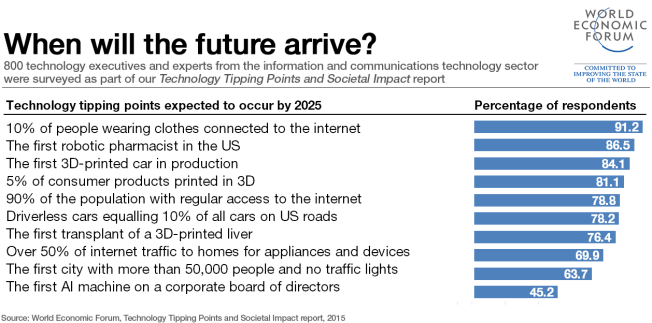
 

A similar study, reported in Forbes, focuses more on how we will change as humans by 2030. It’s not about augmented reality, it’s about augmented us.

Transportation/Sustainable Energy–Hydrogen powered trains will be coming to Germany by 2021.  The technology is being built by French concern, Alstom.

Robotics/AI–China announced plans to open a fully automated police station, sans humans.  The facility will deal primarily with driving -related issues, making it more like a western motor vehicle department facility.  It’s all in line with China’s stated goal of being world leader in artificial intelligence by 203o.

A reminder that the Seeking Delphi™ podcast is available on iTunesPlayerFM, blubrry , and has a channel on YouTube.  You can also follow us on Facebook.

Unknown's avatar

Book Review: Life 3.0, Being Human In The Age of Artificial Intelligence, by Max Tegmark

“The short answer is obviously that we have no idea what will happen if humanity succeeds in building human-level AGI.”–Max Tegmark, in Life 3.0


Reprinted with permission of the publisher, my review of Max Tegmark’s new book, from the November/December issue of Age of Robots.

Full issue available for download here.

LIFE 3.0: BEING HUMAN IN THE AGE OF ARTIFICIAL INTELLIGENCE Max Tegmark ©2017, Borzoi Book published by Alfred A. Knopf, New York, 364p. Review by Mark Sackler


Max Tegmark is not one to shy away from bold scientific pronouncements. The MIT cosmologist and physics professor is perhaps best known for his taxonomy of a four level multiverse—some levels of which are predicted by certain theories, but none of which have been proven to exist. In his previous book, Our Mathematical Universe, My Quest for the Ultimate Nature of Reality, he offers the astounding conjecture that the whole of reality may be nothing more than pure mathematics.


So, what, if anything, makes Life 3.0, Being Human in The Age of Artificial Intelligence different? Unlike a universe of multiverses, or of pure mathematics, it deals with issues that are right in front of our faces. And his taxonomy of Life 1.0, 2.0 and 3.0 is not a mere conjecture that can’t yet— or might never—be tested. Artificial
intelligence is happening right in front of us, and we have a multiplicity of issues to deal with, while we still can control it. Even as Stephen Hawking and Elon Musk are shouting loudly about the potential dangers of artificial intelligence, and many actual AI researchers are countering that the dangers are overblown and distorted, Tegmark is doing something to bridge hype and reality. Or at least, he’s trying to. The problem is, there is no consensus even among the experts. He provides the reader with a wide range of scenarios. Many are not pretty—from a corporation using advanced AI to control global markets and ultimately governments, to a runaway AI that discards human intervention to rule the world itself. And yet, he asserts, all of the scenarios he presents have actual expert believers in their possibility.

The ultimate answer is, we don’t know. Tegmark is not so much warning against its development—it’s probably impossible to stop—as he is advising about its challenges, opportunities and dangers. He knows that the experts don’t really know, and neither does he. But he’s not afraid to present bold scenarios to awaken our awareness. He sums it up best in Chapter 5, Intelligence Explosion:

The short answer is obviously that we have no idea what will happen if humanity succeeds in building human-level AGI. For this reason, we’ve spent this chapter exploring a broad spectrum of scenarios. I’ve attempted to be quite inclusive, spanning the full range of speculations I’ve seen or heard discussed by AI researchers and technologists: fast takeoff/ slow takeoff/no takeoff, humans/ machines/cyborgs in control. I think it’s wise to be humble at this stage and acknowledge how little we know, because for each scenario discussed above, I know at least one well-respected AI researcher who views it as a real possibility.

Tegmark makes is clear, that for all the unknowns, we need to proceed with caution. Bold conjectures and scenarios sometimes turn into realities. And some of these potential realities are not where we want to go. Decisions we make about machine intelligence in the next few decades will go a long way to deciding the future of humanity—our evolution or even our continued existence. He goes on to present possible scenarios for what we might look like in 10,000 and even 1 Billion years. It’s fascinating, but mind-numbing. We simply might not be able to control any of it.

You can follow Seeking Delphi and me on Facebook and Twitter.

Unknown's avatar

Podcast #17: IEEE and Ethical Considerations In Artificial Intelligence and Autonomous Systems

“The real question is, when will we draft an artificial intelligence bill of rights? What will that consist of? And who will get to decide that?” —Gray Scott


Gray Scott’s comment aside, there are more pressing issues than a robot bill of rights.  Artificial intelligence development is progressing at an ever accelerating rate, and bringing with it questions of privacy, unemployment, and potential malevolent uses of the technology.  In this edition of the Seeking Delphi™ podcast, I talk with author John C. Havens about these issues.   He’s executive director of the IEEE Global Initiative for Ethical Considerations In Artificial Intelligence and Autonomous Systems.

Links to relevant stories appear after the audio file and embedded YouTube video below.  A reminder that Seeking Delphi is available on iTunes, PlayerFM, and has a channel on YouTube.  You can also follow us on Facebook

Follow me on twitter @MarkSackler


Episode #17: Ethical Considerations in Artificial Intelligence and Autonomous Systems with John C. Havens

YouTube slide show of Episode #17


John C. Havens biography

IEEE Global Initiative for Ethical Considerations in Artificial Intelligence and Autonomous Systems

Heartificial Intelligence on Amazon

Dubai appoints state minister for A.I.

India appoints experts to advise government on A.I.

Tesla announces addition of new autopilot features in the near future

Eric Schmidt warns U.S. on China’s impending lead in A.I.

Saudi Arabia’s newest citizen, Sofia


Subscribe to Seeking Delphi™ on iTunes 

Subscribe to Seeking Delphi™ on PlayerFM

Subscribe on YouTube

Follow Seeking Delphi™ on Facebook @SeekingDelphi

Follow me on twitter @MarkSackler

Unknown's avatar

Podcast #16: Options for Future Human Evolution

“If evolution really works, how come mothers only have two hands?”–Milton Berle

“There are no shortcuts in evolution.”–Louis Brandeis

Milton Berle was simply funny;   Louis Brandeis is about to be proven  wrong.  Humanity is on the cusp of a new era, full of promise and peril.  We are on the verge of directing our own evolution, and when that comes, it will come at a breakneck pace.  Breakthroughs in biotech and info-tech are rapidly hurtling us towards an age of self-directed evolution.  It will be change by choice, not by chance.  What are those choices, and how will we deal with them? How will it change what it means to be human?  That is the subject of a forthcoming book by futurist Linda Groff,  who joins me as my guest on this episode of Seeking Delphi.™

Links to relevant stories appear after the audio file and embedded YouTube video below.  A reminder that Seeking Delphi is available on iTunes, PlayerFM, and has a channel on YouTube.  You can also follow us on Facebook.


Episode#16: Options For Future Human Evolution


Linda Groff, bio.

Global Options and Evolutionary Futures

News Story Links

Kalashnikov hover bike

Renault hover car design contest winner

Senate subcommittee unanimously approves self-driving car legislation 

Sex robot damaged beyond repair at arts festival in Austria


Subscribe to Seeking Delphi™ on iTunes 

Subscribe to Seeking Delphi™ on PlayerFM

Subscribe on YouTube

Follow Seeking Delphi™ on Facebook @SeekingDelphi

Follow me on twitter @MarkSackler

Unknown's avatar

The Future This Week: August 28, 2017

 “Millions long for immortality who don’t know what to do with themselves on a rainy Sunday afternoon.”–Susan Ertz

Like it or not, anti-aging reasearch–the quest to slow, stop, or even reverse the aging process, has gone mainstream.  Several serious projects have been funded, animal and even human trials of age retarding pharmaceuticals have begun.  It isn’t just on the fringe, anymore.

Aging/rejuvenation therapy research– The Longevity Fund just completed its second round of capital raising, to the tune of $22 million US dollars.  It aims to invest in all manner of enterprises looking to boost human lifespan.  And it was founded by 23-year-old Laura Deming–she is certainly thinking ahead.

Electric Vehicles-The latest report on Tesla’s proposed new all-electric semi-truck, is that it will have a range of 200-300 miles.  They also assert that use of it’s auto-pilot feature could reduce crashes by up to 40%, though with the limited range it is not likely to make a significant dent (pardon the expression) in that rate any time soon.  The truck has been promised to be available as soon as next month.

Airline Travel–Qantas has set in motion a very tentative plan to launch the world’s longest regularly scheduled airline route.  They hope to begin service between Sydney and London by 2022.  There’s just one problem.  The key word is tentative–there is no current model airliner capable of a flying that far without refueling.  Qantas has thrown down the challenge to Boeing, Airbus, and others: develop one.

Flying Taxis–Speaking of aircraft manufacturer’s, Airbus intends to launch an urban, autonomous flying taxi service, and do it soon.  Worry no more about traffic jams on the ground–and let the FAA and other air transportation regulators worry about traffic jams in the sky.  Boeing says they will be flying by the end of this year.

Machine-brain Interface–The journal Science reports that engineers at Northeaster University have published a breakthrough study on miniaturized antennas.  The devices are 100-times smaller than any previously possible, and may be used to enable  implants in the brain and micro–medical devices, not to mention tiny consumer electronics.

Creative Artificial Intelligence–The world’s first music album,  composed and arranged by AI in collaboration with a human artist has been released by Amper Music.  The A.I. does almost everything except perform. That is left to popular internet artist Taryn Southern, backed by professional studio musicians. Southern wrote the lyrics and the vocal melody. See the YouTube video below.

Coming Attractions–The next Seeking Delphi™ podcast will feature an interview with Bloomlife CEO and co-founder Eric Dy.  The company’s health monitoring device that keeps tabs, simultaneously, on pregnant women and their unborn babies,  recently won an impressive innovation contest.

A reminder that the Seeking Delphi™ podcast is available on iTunesPlayerFM, blubrry , and has a channel on YouTube.  You can also follow us on Facebook.

Unknown's avatar

Podcast #12: Artificial Emotional Intelligence

“Your intellect may be confused, but your emotions will never lie to you.”–Roger Ebert

In episode #11, futurist Ian Pearson spoke to his assertion that artificial intelligence will create jobs.  One of the main reasons for this, he believes, will be the need to provide an emotional human interface between A.I. and its intended beneficiaries, be they patients, consumers, or business clients.  But the field of affective computing is rapidly developing artificial intelligence that can read and respond to human emotion.  They are systems with emotional intelligence.   In episode #12, I talk with author Richard Yonck.  His new book,  Heart of the Machine, provides a comprehensive overview of the current state of development in emotional A.I.,  while providing cogent scenarios projecting where it might lead us in the future.

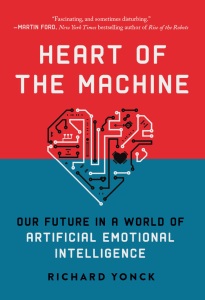
Links to relevant stories appear after the audio file and embedded YouTube video below.  A reminder that Seeking Delphi is available on iTunes and PlayerFM,  and has a channel on YouTube.  You can also follow us on Facebook.


Podcast #12: Artificial Emotional Intelligence


You Tube Slide Show of Episode #12

Richard Yonck’s background on Intelligent-Future.com

Heart of The Machine on Amazon and Barnes and Noble.

Ray Kurzweil’s review of Heart of The Machine in the New York Times.

News items:

Atlanta sets goal to run on 100% renewable energy by 2035.

SpaceX plans to begin launch of global network of internet providing satellites in 2019

University of Houston Master of Science in Foresight web page

Subscribe to Seeking Delphi on iTunes 

Subscribe on YouTube

Follow Seeking Delphi on Facebook @SeekingDelphi

Follow me on twitter @MarkSackler