“Sustainability is no longer about doing less harm. It’s about doing more good.” ―Jochen Zeitz
Click for Amazon link.
In January of 2017 the first two episodes of Seeking Delphi™ featured David Wood, chair of the London Futurists, on his book The Abolition of Aging. Wood’s newest effort, Sustainable Superabundance: A Universal Transhumanist Invitation, is an apt follow-up. It deals with the challenges and opportunities that lie ahead; it maps out his preferred scenarios for a better world, while warning about the dangers of making a worse one. David joins me in this episode for a discussion of some the key ideas in his new book.
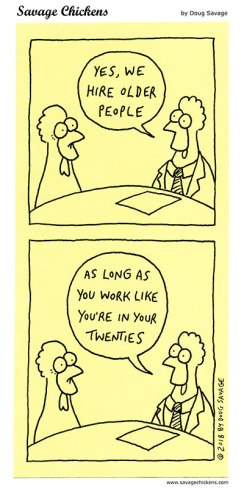
Being in the category that society generally classifies as “old people,” I’m not sure whether to laugh or cry when I look at the cartoon to the left. But if the science progresses fast enough, and I live long enough, maybe I’ll see the day when I can just ignore it. As the increasingly global movement to reverse human aging gains momentum, we might see the day when everyone works like they are in their 20’s, no matter how old they are. In this special edition podcast Aubrey de Grey returns to Seeking Delphi™ to preview the 2019 Undoing Aging conference, to be held in Berlin, Germany, March 28-30. Aubrey previously was on Seeking Delphi™ in December of 2017, episode #19.
I’ll be attending the conference, look for me if you go.
Artificial Intelligence–it seems there is no hotter topic in the tech world these days. Economists try to calculate its potential effects on jobs, car companies aim to tame it for autonomous driving, and big thinkers ala Elon Musk and Stephen Hawking espouse existential worries. But the effects potentially dig down deeper, broader, and perhaps with more subtlety in many other areas of human experience. One sometimes overlooked area of artificial intelligence influence is the effects it may have specifically on women’s issues–both in the workplace and in the home. Alexandra Whittington, of Fast Future Publishing, joins host Mark Sackler for a discussion of these issues on episode #25 of Seeking Delphi.™
Alexandra Whittington is a futurist, writer, foresight director of Fast Future, and faculty member on the Futures program at the University of Houston. She has a particular expertise in future visioning and scenario planning. Alexandra is a contributor to The Future of Business, Beyond Genuine Stupidity—Ensuring AI Serves Humanity, and The Future Reinvented—Reimagining Life, Society, and Business, and a co-editor for forthcoming books Unleashing Human Potential—The Future of AI in Business and 50:50—Scenarios for the Next 50 Years.
Click image for link
Episode #25: Women and The Future of A.I. with Alexandra Whittington
This special edition of the Seeking Delphi™ podcast provides a preview of the 2018 IEEE Technology Time Machine, to be held October 31-November 1, at the Hilton Resort and Spa, San Diego, CA. Joining host Mark Sackler to discuss the upcoming program is Roberto Saracco, who heads the IEEE initiative on Symbiotic Autonomous Systems and is one of the conference organizers. He was previously interviewed on Seeking Delphi Podcast #22. See links below the embedded podcast audio and YouTube slide show to access event information and registration.
Get ready for all A.I., all the time. It’s the lion’s share of the news this week. After all, Rana el Kaliouby says, among other things, that it should ultimately be pervasive. In this week’s tech press, it pretty much is. I did throw in a space story, if only for accent–and maybe to appease those who’ve had enough of machine intelligence.
While you’re reading about all this week’s future-related news, don’t forget that you can subscribe to Seeking Delphi™ podcasts on iTunes, PlayerFM, or YouTube(audio with slide show) and you can also follow us on Twitter and Facebook
In the popular HBO series Westworld, robotic hosts are depicted as being placed into a kind of psychiatric analysis by their creators. Could this actually happen one day? Joanne Pransky thinks it will. She bills herself as the World’s First Robotic Psychiatrist® (yes, she even registered that title!). She was dubbed the real life Susan Calvin by Isaac Asimov, after the robot psychologist he created in his classic 1950 short story anthology, I, Robot. In this episode of the Seeking Delphi™ podcast, host Mark Sackler talks to her about this and other significant issues in the man/machine relationships to come.



 Alexandra Whittington is a futurist, writer, foresight director of Fast Future, and faculty member on the Futures program at the University of Houston. She has a particular expertise in future visioning and scenario planning. Alexandra is a contributor to The Future of Business, Beyond Genuine Stupidity—Ensuring AI Serves Humanity, and The Future Reinvented—Reimagining Life, Society, and Business, and a co-editor for forthcoming books Unleashing Human Potential—The Future of AI in Business and 50:50—Scenarios for the Next 50 Years.




 Seeking Delphi™