Unknown's avatar

The Future This Week: November 28, 2017

“Always make the audience suffer as much as possible.”–Alfred Hitchcock

It seems movie theater owners are taking Hitchcock quite literally.  At our first break from home binge watching in almost a year, my wife and I went to a local cinema. We arrived right on the dot at the advertised starting time of the movie, and immediately suffered through 20 minutes of commercials–exactly what we get away from by watching Amazon and Netflix and premium cable channels.  I just love paying to binge watch commercials.

 While you’re reading about all this week’s future-related  news, don’t forget that you can subscribe to Seeking Delphi™ podcasts on iTunes or PlayerFM, and you can also follow us on Twitter and Facebook 

Digital entertainmentAmazon, Apple, and Netflix  are expected to be spending nearly $20 Billion, combined, on digital content by 2022.  Take that, Bollywood.

The Venture Reality Fund reports that Hollywood’s investment in AR and VR is booming.  Overall, AR/VR investment in the second half of this year is seen as rising by $2.3 billion, or 79 per cent, over the same period a year ago.  Oh boy, even those insufferable commercials will be enhanced.

The worm turns–on mars.

Space Travel/Colonization–What’s better than pigs in space?  How about worms on Mars?  A recent study by researchers at Wageningen University found that earth worms can grow and reproduce in Martian-like soil. It’s part of a study to see if food plants can grow in the same compound, to support potential colonization.

–Woody Allen once said, “man can’t live on bread alone; often there must be a beverage.”  Anheiser-Busch is taking that literally by sending beer into space.  A Dec. 4 SpaceX launch will send beer making ingredients to the international space station, a very early step toward sending it to Mars with the first colonists.  Talk about opening new markets.

Future Life/2030 Forecasts–A new report from The World Economic Forum paints a heady picture of life in the year 2030.  Genetically engineered pets…smart toilets…internet connected clothes…wow, I can hardly wait.
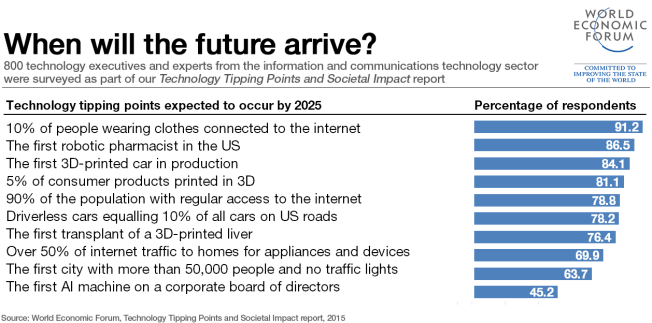
 

A similar study, reported in Forbes, focuses more on how we will change as humans by 2030. It’s not about augmented reality, it’s about augmented us.

Transportation/Sustainable Energy–Hydrogen powered trains will be coming to Germany by 2021.  The technology is being built by French concern, Alstom.

Robotics/AI–China announced plans to open a fully automated police station, sans humans.  The facility will deal primarily with driving -related issues, making it more like a western motor vehicle department facility.  It’s all in line with China’s stated goal of being world leader in artificial intelligence by 203o.

A reminder that the Seeking Delphi™ podcast is available on iTunesPlayerFM, blubrry , and has a channel on YouTube.  You can also follow us on Facebook.

Unknown's avatar

The Future This Week, August 21, 2017

“I wish I had never gotten involved with steroids.  It was wrong. It was stupid.”–Mark McGuire

I’ve been saying it since I first learned about CRISPR/Cas9 gene editing, two years ago.  It’s going to happen.  Maybe it has even already happened.   Performance enhancing drugs will be a thing of the past;  they will be replaced by performance enhancing genetics.

Genetic editing/human enhancement–In a wide ranging article in Next Big Future, the potential for athletic performance enhancement is analysed.  Is the super-human athlete coming?

Robotics/Artificial Intelligence–In an open letter to the United Nations, leading industrialists in the robotics and A.I. field urged an immediate global ban on autonomous weapons.  The group of 116 business leaders from 26 companies included Elon Musk, and Mustafa Suleyman, founder and Head of Applied AI at Google’s DeepMind.

DARPA announced a new program to develop better means of testing, adapting and predicting the behavior of autonomous machine learning systems.  One objective of the effort, called assured autonomy is to get beyond the predominant view of assurance systems, that such algorithms, once deployed (say, as in self-driving cars) will not learn and evolve beyond our control.  (A subject covered in Seeking Delphi™ podcast #14 on self-replicating machines).

–Robots don’t have to threaten your life or evolve out of control to be creepy.  Check out the dancing robots in the YouTube video below.

 Electric/Autonomous Vehicles–Remember the Volkswagon hippie microbus of the 1960’s?  The German automaker now plans a 21st century version of the vehicle;  it will be electric and have level 3 autonomy.    Debut is planned for 2022. Just add a peace sign, blast Jimi Hendrix on the sound system, and you are ready to go.


Wearable devices/material science–A university in China reports being able to create strong, flexible silk–that even conducts electricity, by feeding graphene to silk worms.   The resulting material could be used for a new class of wearable health sensors and create flexible robot bodies.

Coming Attractions–Speaking for wearables, the next Seeking Delphi™ podcast will feature an interview with Bloomlife CEO and co-founder Eric Dy.  The company’s health monitoring device that keeps tabs, simultaneously, on pregnant women and their unborn babies,  recently won an impressive innovation contest.

A reminder that the Seeking Delphi™ podcast is available on iTunesPlayerFM, blubrry and , and has a channel on YouTube.  You can also follow us on Facebook.

Unknown's avatar

The Future This Week: August 14, 2017

“Life isn’t a tiptoe through the tulips.”–Shannon Hoon

“When tulip mania dies down, all that remains are pretty flowers.”–Adam Cohen

I understand the value of cryptocurrency–I think.  But the valuation? Forget it.  Investors’ lives certainly won’t be a tiptoe through the tulips when and if the Bitcoin bubble bursts.  But I’ll still love hearing Tiny Tim sing about it.  And yes, tulips are still pretty flowers.

Bitcoin/Cryptocurrency–The price of a single Bitcoin topped $4,000 for the first time.  Is cryptocurrency the future of our economy?  I have my doubts.   And if you are looking for a way to short it, that makes two of us.

Semi-conductors/material science--With transistor miniaturization in silicon-based microchips rapidly reaching its physical limit,  Moore’s law could also be coming to an end.  But researchers at Stanford University have identified two semi-conductors that could extend the limits of silicon-based miniaturization by augmenting its properties.

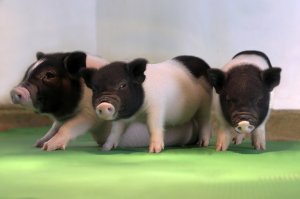
Does “too cute to eat” also mean, “too cute to accept an organ transplant from?’

Biotech/gene editing–A group led by Dr. George Church, of Harvard University, has succeeded in using gene-editing to make piglets more suitable for growing replacement human organs.   Dr. Church believes that the first pig-to-human organ transplants may be as close as two years away.

Robotics/Artificial Intelligence–The premiere issue of Age of Robots has hit the digital newsstands.  My article, Self Replicating MachinesScience Fiction vs. Science Fact, appears, along with stories on artificial intelligence, medical robots,  machine consciousness, and more.

   Quantum Reality–A future after death? The notion of life after death has always been the exclusive realm of the spiritual/religious world–until now, that is.  Physicist and author Roger Penrose,  along with some others with impressive scientific credentials, now believe that information stored in our brains in a quantum state may live on, along with our consciousness, after we die.  This report, on the Galaxy Today web page, hints at any number of ideas which I have expounded on in my other blog,  The Millennium Conjectures.

A reminder that the Seeking Delphi™ podcast is available on iTunesPlayerFM, blubrry and , and has a channel on YouTube.  You can also follow us on Facebook.
Unknown's avatar

The Future This Week: August 7, 2017

“Your genetics is not your destiny.”–Dr. George Church

I’d like to ask Dr. George Church a question about the above quote.  Does he mean that nurture can overcome nature?  Or does he mean your genetics can be changed?  Considering he’s one of the leading geneticists in the world, and is closely involved in one or more enterprises involved in gene editing, I’m guessing it would be the latter.  Either way, CRISPR/Cas9 gene editing was prominent in news this past week.

CRISPR/Cas9 genetic editing–A multinational team of American, Korean, and Chinese researcher succeeded in correcting a serious genetic disease in human embryos.  The paper appeared online in the journal Nature and was widely reported by various news sources.  While creating excitement for the technique’s potential, it also raised concerns for the potential advent of genetically modified “designer” babies.

UC, Berkeley researcher, and CRISPR co-developer, Dr. Jennifer Doudna, weighed in on the Nature paper, along with views on a variety of potential uses and abuses of the technology.  In a wide ranging interview with Newsweek, she mentioned cancer, diabetes and bio-terrorism as potential targets the technology could be used to fight.

Researchers at the University of Chicago reported success with CRISPR created skin grafts in treating diabetes in mice.  While not technically a cure, it could provide an effective long term treatment alternative to insulin shots.  The researchers also asserted that the technique could be useful in treating a variety of other diseases.

A brief explanation of CRISPR gene editing


3D Bio-printing–Doctors at Rutgers Robert Wood Johnson medical school successfully inserted a 3D printed bone replacement implant in a patient who had suffered irreparable damage to a portion his skull.  Such a procedure was unthinkable just a few years ago and may be an indicator that bio-printing is on the verge of becoming a major health industry.

Robotics/Automation–Zume Pizza, of Mountain View, CA, has taken a Silicon Valley approach to making their pies.  They use robots.  While humans have not been completely automated out of the process, the robots do the repetitive parts of the process.

 Politics–According to WIRED, there is a good reason why people can’t stop talking about Mark Zuckerberg as a 2020 presidential candidate.  That reason is Mark Zuckerberg; his actions speak louder than his words.

Renewable Energy–Fresh on the heels of Atlanta’s goal to achieve 100% renewable energy by 2035, California is poised to set a statewide goal to do the same by 2045.  A bill mandating just that has passed a  committee in the state senate.  Governor Jerry Brown is expected to sign it if it becomes law.

A reminder that the Seeking Delphi™ podcast is available on iTunesPlayerFM, blubrry and , and has a channel on YouTube.  You can also follow us on Facebook.

Unknown's avatar

The Future This Week: July 24, 2017

“When something is important enough, you do it even if the odds are not in your favor.”–Elon Musk

“I want to die on Mars; just not on impact.”

I see a major quandary going forward with this feature.  Elon Musk quotes may run out before Elon Musk stories run out.  And Elon Musk stories will run out, like, never.  Though this week, a couple of the stories could easily be categorized as anti-Musk.

HyperloopElon Musk says The Boring Company has received verbal government go ahead to tunnel from New York to Washington, DC.  The hyperloop that would run within it could make the run in 29 minutes, vs. the 3+ hours by Amtrak, and could begin construction in as little than 4-6 months, he asserts.

More than one observer thinks Musk is blowing smoke on the rapid startup envisioned for the NY-DC loop.  Government approval for large scale infrastructure projects don’t get done in months; they take years or even decades.

Artists conception of an underground Hyperloop station

Robotics–The L. A. Times reports that a critical shortage of migrant farm workers in California is being met by a move to robotic crop pickers.  It still has a way to go, but after years of crackdown on illegal immigration, there appears to be no other way to go.

Artificial Intelligence–China wants to be the world leader in A.I. by 2030, reports the N.Y. Times. They project a domestic industry worth $150 billion yearly.  That’s a lot of yuan.

It’s not just government project proposals that Elon Musk doesn’t understand.  According to Rodney Brooks, the founding director of MIT’s Computer Science and Artificial Intelligence Lab, Elon doesn’t know much about artificial intelligence, either.  Speaking in an interview with Tech Crunch, Brooks said that the one thing that Elon, and all of the other naysayers who warn of existential risks in A.I.,  have in common, is that none of them work in A.I.

Autonomous Vehicles–The Verge reports that buyers of autonomous vehicles could effectively face planned obsolescence as technical capabilities advance rapidly.  The last time I heard that phrase in regards to cars, it referred to the size and shape of tail fins, circa 1960.

1959 Chevy Impala tail fins. They got smaller in 1960 and again in 1961, and disappeared altogether in 1962. Planned obsolescence.


A reminder that the Seeking Delphi™ podcast is available on iTunesPlayerFM, blubrry and , and has a channel on YouTube.  You can also follow us on Facebook.
Unknown's avatar

The Future This Week: July 17, 2017

“The moon is a friend for the lonesome to talk to.”–Carl Sandburg

I don’t know about the moon, but when it comes to Mars, it does not appear that NASA will be doing much more than saying hello in the foreseeable future.  It seems there’s this little problem of money.  On the other hand, it’s full speed ahead to the lunar surface for at least one private enterprise.

Space Exploration and Technology–NASA has finally admitted what experts have been saying for some time.  It does not have enough money to land astronauts on Mars.  They could get astronauts there and orbit, but not land.  So I suppose they could say hello.

Moon Express is full speed ahead on its own ambitious space project.  They recently announced plans to launch a series of robotic lunar mining missions, the third of which will bring back samples from the surface in 2020.  The company is racing four other enterprises as finalists for the Lunar X Prize of $20 milllion, which will be awarded to the first private venture to land a rover on the moon and send back high definition pictures.

eCommerce/Retailing– According to retail guru Brittain Ladd,  Amazon could become the largest U.S. grocery retailer by 2030, if their proposed takeover of Whole Foods goes through.   Ladd predicts Amazon will pass U. S. #2 retailer Kroger by 2025 and take over the top spot from Walmart sometime between 2027 and 2030.

Electric Cars–The greatest roadblock to massive roll out of electric cars may not be infrastructure, but batteries.  Volkswagon, says that as many as 40 new giga-factories may be needed to meet global demand by 2025.

Transhumanism/Brain interface–DARPA has awarded a contract to six organizations, to be led by the University of California, Berkeley, to develop implantable interfaces that could transmit images and sound directly into the brain.  The aim is to compensate for natural visual or hearing loss.  (Reference back: in Seeking Delphi™ podcast #10, on the future of cinema and digital entertainment, film maker Steven Katz discussed this possibility.)

CRISPR/genetic editing–A team of researchers from Harvard and MIT are casting doubt on an earlier study that found that CRISPR/Cas9 gene edits could introduce unexpected mutations.  The original study was done by Columbia University.  It should be noted, however,  that the Broad Institute, a joint venture of Harvard and MIT, is in a pitched patent battle with the University of California, Berkeley, for rights to various uses of the technology.   CRISPR gene editing has the potential to change the face of human health, and perhaps even enter the domain of trans-humanism.  See video embedded below.

In the meantime, researchers at UC San Francisco and UC Berkeley (no surprise there) say they have synthesized a protein they call anti-CRISPR which shut of mutations in CRISPR altered genes.


Robotics/Artificial Intelligence–It seems that a security robot has committed suicide in Washington, DC.  After sounding a security all-clear, it threw itself into a pool.


Coming Attractions:  I’ll be attending the annual meeting of the Association of Professional Futurists July 27-29 in Seattle.  More to come on that.

A reminder that the Seeking Delphi™ podcast is available on iTunesPlayerFM, blubrry and , and has a channel on YouTube.  You can also follow us on Facebook.