Unknown's avatar

The Future This Week: October 31, 2017

“Aging is mostly the failure to repair”– Gregory Benford

“Age is inevitable; aging isn’t”–Marv Levy

Even as lifestyle issues like smoking, obesity, distracted driving and drug overdoses have of late limited life expectancy gains in the west, there continue to be breakthroughs in anti-aging research at breathtaking pace.  At some point–maybe soon–we may experience a period of anti-aging therapy deployment such that average life expectancy increases by one or more years every year. How long will we live, then?  And the bigger question is: what will be the implications for civilization and the earth as a whole?

 While you’re reading about all this week’s future-related  news, don’t forget that you can subscribe to Seeking Delphi™ podcasts on iTunes or PlayerFM, and you can also follow us on Twitter and Facebook 

Anti-aging/Longevity research–Virtual biotech company, Youthereum, believes they can extend healthy human lifespan by 30% using epigenetics.  The idea of such an approach as  has been around for decades; they believe they are in striking range of achieving it.  The unconventional part of the plan is not the science, it’s financing the research, which they hope to accomplish through an ICO (Initial Coin Offering) of a new cryptocurrency.

Two University of Arizona scientists have published a paper on the mathematics of aging, purporting to prove that immortality is impossible.  That sounds suspiciously like the scientist who published a paper supposedly proving that space travel was impossible, just a few months before the launch of the first Sputnik.

Food– Food distribution giant, Cargill, Inc., has joined the likes of Bill Gates and Richard Branson with investments in Memphis Meats.  The San Francisco-based (not Tennessee) company says its products–lab grown beef, chicken and duck–will be in stores by 2021 and will eventually cost as little as $1 a pound.  The products use real animal cells, but obviate the need to raise and kill live animals.

Space Launch and Propulsion–Positron Dynamics is projecting the potential launch of an anti-matter propelled cubesat by as early as sometime next year.  It further forecasts that a Mars-bound anti-matter powered rocket could be launched by the 2030’s.

–Meanwhile, Elon Musk’s SpaceX continues to make progress towards lowering the cost of space launches.  This past week, it conducted its fifteenth consecutive successful launch and first stage landing of the reusable Falcon 9 rocket.

China/Economic Development–The New York Times reports that Chinese president Xi Jinping wants to fully eliminate poverty in his country by 2020.   It’s all part of the larger Xi plan which outlines many of the country’s goals, including those in healthcare, AI, and the sharing economy, through 2050.

A reminder that the Seeking Delphi™ podcast is available on iTunesPlayerFM, blubrry , and has a channel on YouTube.  You can also follow us on Facebook.

Unknown's avatar

The Future This Week: October 23, 2017

 “I think we are at the dawn of a new era in commercial space exploration.”–Elon Musk

Nothing accelerates technological development like competition. It was the competition between the US and the Soviet Union that put a man on the moon in 1969, decades sooner than it would otherwise have occurred.  The finish line of that race ended the competition, and we haven’t gone back since.  But a new competition, multi-faceted and far more diverse, has begun.  The commercial development of space figures to re-accelerate our push into the final frontier. If you’re a fan of space exploration and exploitation, stay tuned, the next few years are going to be exciting.

 While you’re reading about all this week’s future-related  news, don’t forget that you can subscribe to Seeking Delphi™ podcasts on iTunes or PlayerFM, and you can also follow us on Twitter and Facebook 

Fly me to the moon…in 2022

Space exploration/exploitation/tourismUnited Launch  Alliance and Bigelow Aerospace have announced a joint venture to place a habitat in lunar orbit by 2022.  While they describe fully how they intend to get it there, they don’t yet say who will inhabit it or what it might be used for.  Anyone want to rent a lunar-orbiting apartment?

Richard Branson says his Virgin Galactic commercial space venture will launch its first astronauts into space in about 4 months.  He also says his program will do more for humanity than Elon Musk’s ambitious SpaceX plans to colonize Mars.  Branson vs. Musk is not exactly USA vs. USSR; in fact,  it might actually be more sustainable.

–Branson and Musk aren’t the only billionaire-sized egos in space.  Jeff Bezos’s Blue Origin announced  a breakthrough that brings it one step closer to launching sub-orbital space tourism flights by 2019. They successfully test fired their new BE-4 rocket engine.

While NASA progresses at a snails pace in returning US astronauts to the moon, it’s ramping up the effort to detect nearby, habitable earth-like planets.  How they will ever get us there is another question, altogether.

Artificial Intelligence–Elon Musk says that the AI in a Tesla will soon be able to predict your destination and bring you there without asking. That’s good; half the time I have no idea where I’m going.  Seriously, though, that’s amazing–and kind of creepy at the same time.

The New York Times reports that tech giants are paying big bucks for the services of Artificial Intelligence experts.  The deals they offer them often include signing bonuses and multi-year contracts, sometimes resembling those offered to professional athletes.

–Dubai and India are both jumping on the A.I. bandwagon, as far as government monitoring and regulation is concerned.  Dubai is appointing a minister of artificial intelligence, while India is establishing an expert panel to advise government on policy.

Biotechnology–An Italian neurosurgeon says he will conduct the world’s first full head transplant in December of this year.  And you were skeptical of self-driving cars.

A reminder that the Seeking Delphi™ podcast is available on iTunesPlayerFM, blubrry , and has a channel on YouTube.  You can also follow us on Facebook.

Unknown's avatar

The Future This Week: October 2, 2017

“Mars is there, waiting to be reached.”–Buzz Aldrin

“I want to die on Mars.  Just not on impact.”–Elon Musk

Ah, Mars.  Indeed it does seem to be just sitting there for the taking.  And while I do appreciate Elon Musk’s desire not to die there on impact, I’m not so sure he cares whether you die there on impact.  Or here on Earth, either, for that matter.  His Mars ambitions are all over the news this week. As is usual for ‘ol Elon, they seem, well, over ambitious.

 While you’re reading about all this week’s out of this world news, don’t forget that you can subscribe to Seeking Delphi™ podcasts on iTunes or PlayerFM, and you can also follow us on Facebook.

Mars/rocketry–The latest SpaceX pronouncement from Elon Musk, is that he aims to put humans on Mars by 2024.  To attain that ambitious goal, he’s planning a new rocket design. It replaces the previous ITS (Interplanetary Transport System) design, with a new one called BFR.  What does BFR mean?  Well, its a BFD.

–Apparently Mars isn’t the only place Elon Musk wants to send you via his new BFR.   He also wants to use it for very fast air transport on Earth.   He might think it’s a good idea, but others not so much–as this article in The Verge suggests.

–Will we ever find Martians?  NASA’s Mars 2020 rover aims to look for them. Or rather, for the carbon signatures of past Martian microbes, using a super hot laser technology.

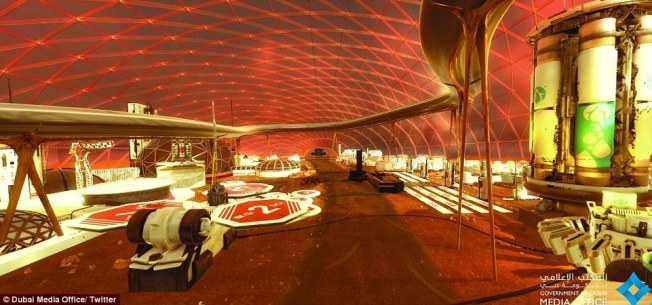
–Speaking of colonizing Mars, the United Arab Emirates has stated a goal of building a major metropolis on Mars within 100 years.  They plan to build a prototype right hear on Earth to test out the needed survival technologies. 

Home sweet Home–Mars habitat

Electric/next generation vehicles–Even as Elon Musk goes over the top with his rocketry ambitions, the bottom has, in a way, fallen out of his electric vehicle ambitions.   It turns out that only 260 new Model 3 Teslas were produced in third quarter, versus an original projection of at least 1,500.

–Elon isn’t the only one with an aggressive agenda for electric vehicles.  GM has announced they plan to introduce some 20 new all-electric models by 2023.

BMW says they will add Amazon’s Alexa to their 2018 models.  Great, it’s bad enough when that GPS voice gets all snarky on you; now there will be two of them.

Blockchain–Move over cryptocurrencies and other financial applications powered by blockchain.  The CDC wants to use the technology to track disease outbreaks for the betterment of public health.

–Speaking of cryptocurrency, South Korea has joined China in banning new ICO’s.  Initial Coin Offerings are the cryptocurrency equivalent of stock IPO’s.

Coming Attractions–On the next Seeking Delphi™ podcast, I’ll be speaking with Linda Groff, PhD, on her new book exploring options for future human evolution.  Yes, for perhaps the first time in history, there are options.

A reminder that the Seeking Delphi™ podcast is available on iTunesPlayerFM, blubrry , and has a channel on YouTube.  You can also follow us on Facebook.

Unknown's avatar

The Future This Week, March 5, 2017

“If you want a nation to have space exploration ambitions, you’ve got to send humans.”-Neil deGrasse Tyson

Neil might have added, “or have profit motives.”  The news about commercial space exploration is almost nonstop these days.  Here’s what’s been happening in the past week.

Commercial space ventures–

In more down-to-earth news:


Unknown's avatar

The Future This Week, February 26, 2017

“I would like to die on Mars.  Just not on impact.”–Elon Musk

cropped-mars.jpg

Surprisingly, there is no new Elon Musk news this week.  In an even bigger surprise, Mars was in the news, but without Elon Musk–at least not by name.

Space Exploration–

  • The United Arab Emirates unveiled a 100-year goal to colonize Mars with 600,000 people.  The public announcement of the Mars 2017 Project came at a World Government meeting held in Dubai and was made in a speech by sheikh Mohammed bin Rashid, in which he emphasized his nations long-term commitment to space exploration.


  • In plans that are much nearer in time and space, the Russian space agency Energia announced plans to send tourists to the moon by 2022.  They say they will sell nine places on its Soyuz space capsule, as soon as this spring, for flights as soon as 2022.  The craft that will loop around the moon before heading to the International Space Station.  This represents an aggressive upgrade from its previous plan,  originally projected to be launched in the early 2030’s.  No indication of price or selection process for tourists was given.  Start saving your Aeroflot frequent flyer miles now.


  • SpaceX (okay, that is an Elon Musk story, at least indirectly) announced a new target date of 2020 for landing a robotic probe on Mars.  This represents a setback from the original target of 2018.

Biotech–

  • Market Research Future released a study projecting that the global bioprinting market, estimated to have been worth $570 million in 2015, will grow at a compound annual rate of 25-27% through 2022.  At present, they estimate that North America holds a 40% share of this market.


Robotics–

  • The private sector is not the only place where workers are being replaced by AI and machines.  The San Diego Union-Tribune reports that the U.S. military is in the process of developing and deploying automation to streamline its support operations and even reduce personnel on the front lines.  Some of the concepts include driverless combat vehicles and robotic frogmen.


Structural engineers may soon be able to determine if London Bridge is falling down--without actually visiting it.

Structural engineers may soon be able to determine if London Bridge is falling down–without actually visiting it.

Virtual Reality–

  • World Architecture News reported that a joint project of Microsoft and the University of Cambridge aims to enable structural engineers to inspect bridges using the Hololens virtual reality headset, rather than traveling in person to the sites.  This would be accomplished by creating a combining composite of photos taken locally by non-experts, allowing expert engineers to zoom in and out and take a virtual walk-around of a structure. The idea is to save the time and cost of travel.