Unknown's avatar

The Future This Week: November 7, 2017

“We’re going to become caretakers for the robots. That’s what the next generation of work is going to be.”–Gray Scott
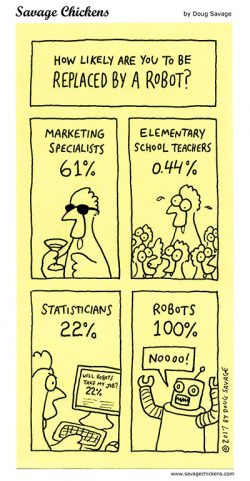
Hmmm.  Will we be caretakers for them, or them for us?  Will there even be a next generation of work? Hot on the heels of my Seeking Delphi™ podcast interview, with John C. Havens, on ethical considerations in artificial intelligence, comes a flurry of additional A.I.-related stories.

 While you’re reading about all this week’s future-related  news, don’t forget that you can subscribe to Seeking Delphi™ podcasts on iTunes or PlayerFM, and you can also follow us on Twitter and Facebook 

Robotics/Artificial Intelligence–In a Seeking Delphi™ podcast interview, author and IEEE consultant John C. Havens, argues that businesses must adhere to triple bottom line standards if A.I. is going to serve humanity in a beneficial way.  That means environmental and employee/customer well-being outcomes as well as profits.

Financial giant, J.P. Morgan Chase, says that A.I. and big data could trigger the next market correction.  This is nothing new, as autonomous computer algorithm trading was a significant driver in  the volatility that led to the 1987 market crash.

The New York Times reports that major tech companies are struggling with a shortage of artificial intelligence programmers.  Their solution?  Automate the process, of course.   In other words build A.I., itself, to build more A.I.

MIT students have tricked an artificial intelligence program into misidentifying a turtle as a gun.  That sounds more like the title of an Oliver Sacks story than a purposeful scientific endeavor.  But the idea was to see if it could be fooled, as a test of the reliability its image recognition capabilities.  Apparently, the students won and the A.I. lost.

Sofia, the new Saudi citizen

–At this point, it seems more like a cheap publicity stunt, but Saudi Arabia granted citizenship to a humanoid robot named Sofia (see YouTube video at the bottom of this post.)  And no less ridiculous–at this early juncture–was Tokyo’s decision to grant residency (whatever that means) to an artificial intelligence logarithm.

Self-Driving Cars–Software bugs are not usually lethal,  but in autonomous vehicles they certainly could be.  IEEE Spectrum reports on a new method for finding and weeding out such bugs before disaster strikes.

Space Exploration/Colonization–Amazon and Blue Origin CEO Jeff Bezos says we have to explore and colonize space in order to save the Earth.— On the other hand, maybe he’s just looking for new markets to monopolize.

Internet of Things–According to analysts at market research group, Reportsnreports, the Internet of Things market will grow more than tenfold to top $185 billion by 2023.  They estimate that the 2016 value was just over $16 Billion.


 A reminder that the Seeking Delphi™ podcast is available on iTunesPlayerFM, blubrry , and has a channel on YouTube.  You can also follow us on Facebook.

Unknown's avatar

The Future This Week: October 31, 2017

“Aging is mostly the failure to repair”– Gregory Benford

“Age is inevitable; aging isn’t”–Marv Levy

Even as lifestyle issues like smoking, obesity, distracted driving and drug overdoses have of late limited life expectancy gains in the west, there continue to be breakthroughs in anti-aging research at breathtaking pace.  At some point–maybe soon–we may experience a period of anti-aging therapy deployment such that average life expectancy increases by one or more years every year. How long will we live, then?  And the bigger question is: what will be the implications for civilization and the earth as a whole?

 While you’re reading about all this week’s future-related  news, don’t forget that you can subscribe to Seeking Delphi™ podcasts on iTunes or PlayerFM, and you can also follow us on Twitter and Facebook 

Anti-aging/Longevity research–Virtual biotech company, Youthereum, believes they can extend healthy human lifespan by 30% using epigenetics.  The idea of such an approach as  has been around for decades; they believe they are in striking range of achieving it.  The unconventional part of the plan is not the science, it’s financing the research, which they hope to accomplish through an ICO (Initial Coin Offering) of a new cryptocurrency.

Two University of Arizona scientists have published a paper on the mathematics of aging, purporting to prove that immortality is impossible.  That sounds suspiciously like the scientist who published a paper supposedly proving that space travel was impossible, just a few months before the launch of the first Sputnik.

Food– Food distribution giant, Cargill, Inc., has joined the likes of Bill Gates and Richard Branson with investments in Memphis Meats.  The San Francisco-based (not Tennessee) company says its products–lab grown beef, chicken and duck–will be in stores by 2021 and will eventually cost as little as $1 a pound.  The products use real animal cells, but obviate the need to raise and kill live animals.

Space Launch and Propulsion–Positron Dynamics is projecting the potential launch of an anti-matter propelled cubesat by as early as sometime next year.  It further forecasts that a Mars-bound anti-matter powered rocket could be launched by the 2030’s.

–Meanwhile, Elon Musk’s SpaceX continues to make progress towards lowering the cost of space launches.  This past week, it conducted its fifteenth consecutive successful launch and first stage landing of the reusable Falcon 9 rocket.

China/Economic Development–The New York Times reports that Chinese president Xi Jinping wants to fully eliminate poverty in his country by 2020.   It’s all part of the larger Xi plan which outlines many of the country’s goals, including those in healthcare, AI, and the sharing economy, through 2050.

A reminder that the Seeking Delphi™ podcast is available on iTunesPlayerFM, blubrry , and has a channel on YouTube.  You can also follow us on Facebook.

Unknown's avatar

The Future This Week: October 23, 2017

 “I think we are at the dawn of a new era in commercial space exploration.”–Elon Musk

Nothing accelerates technological development like competition. It was the competition between the US and the Soviet Union that put a man on the moon in 1969, decades sooner than it would otherwise have occurred.  The finish line of that race ended the competition, and we haven’t gone back since.  But a new competition, multi-faceted and far more diverse, has begun.  The commercial development of space figures to re-accelerate our push into the final frontier. If you’re a fan of space exploration and exploitation, stay tuned, the next few years are going to be exciting.

 While you’re reading about all this week’s future-related  news, don’t forget that you can subscribe to Seeking Delphi™ podcasts on iTunes or PlayerFM, and you can also follow us on Twitter and Facebook 

Fly me to the moon…in 2022

Space exploration/exploitation/tourismUnited Launch  Alliance and Bigelow Aerospace have announced a joint venture to place a habitat in lunar orbit by 2022.  While they describe fully how they intend to get it there, they don’t yet say who will inhabit it or what it might be used for.  Anyone want to rent a lunar-orbiting apartment?

Richard Branson says his Virgin Galactic commercial space venture will launch its first astronauts into space in about 4 months.  He also says his program will do more for humanity than Elon Musk’s ambitious SpaceX plans to colonize Mars.  Branson vs. Musk is not exactly USA vs. USSR; in fact,  it might actually be more sustainable.

–Branson and Musk aren’t the only billionaire-sized egos in space.  Jeff Bezos’s Blue Origin announced  a breakthrough that brings it one step closer to launching sub-orbital space tourism flights by 2019. They successfully test fired their new BE-4 rocket engine.

While NASA progresses at a snails pace in returning US astronauts to the moon, it’s ramping up the effort to detect nearby, habitable earth-like planets.  How they will ever get us there is another question, altogether.

Artificial Intelligence–Elon Musk says that the AI in a Tesla will soon be able to predict your destination and bring you there without asking. That’s good; half the time I have no idea where I’m going.  Seriously, though, that’s amazing–and kind of creepy at the same time.

The New York Times reports that tech giants are paying big bucks for the services of Artificial Intelligence experts.  The deals they offer them often include signing bonuses and multi-year contracts, sometimes resembling those offered to professional athletes.

–Dubai and India are both jumping on the A.I. bandwagon, as far as government monitoring and regulation is concerned.  Dubai is appointing a minister of artificial intelligence, while India is establishing an expert panel to advise government on policy.

Biotechnology–An Italian neurosurgeon says he will conduct the world’s first full head transplant in December of this year.  And you were skeptical of self-driving cars.

A reminder that the Seeking Delphi™ podcast is available on iTunesPlayerFM, blubrry , and has a channel on YouTube.  You can also follow us on Facebook.

Unknown's avatar

The Future This Week: October 9, 2017

“My vision of the future is pretty much standard fare. The rich get richer, the poor get poorer and there are flying cars.”– Joss Whedon

“Flying is learning how to throw yourself at the ground and miss.”–Douglas Adams

These flying car stories just won’t go away.  Now hover cars are in the mix as well–though merely hovering might have no great added value other than saving on tires.  I still think Douglas Adams has the best idea, as long as he’s not talking about cars.

While you’re reading about all this week’s future-related  news, don’t forget that you can subscribe to Seeking Delphi™ podcasts on iTunes or PlayerFM, and you can also follow us on Facebook.

Flying/Hovering/Self-Driving Cars–Boeing has jumped into the fray with flying cars.  They’ve purchased Aurora Flight Sciences, a Virginia-based concerned that has been helping Uber develop flying taxis.

–Yuchen Chai,  a student at UK art and design school Central Saint Martin, won a design contest for a hover car.   The contest was co-sponsored by Renault.  Based on the video at this link, it appears to travel just a few inches over the ground.  I don’t know about you, I would rather travel over the traffic then over the road.

Chevy Cruise Car, touted as first mass-producible self-driving car

Meanwhile, back on the ground, GM has purchased LIDAR sensor company Strobe, Inc.   The purchase will help then accelerate their race with Tesla, Alphabet, Uber, and who knows how man other enterprises, to rush self-driving cars to market.

At least one technology expert says humans should not be trusted to drive.  Omar Rohim, CTO of UK concern Energi Mine,  says our emotions get in the way of safe driving, and predicts that in 25 years we will be banned from driving ourselves–AI will take over everything.  This story comes on the heels of a US Senate subcommittee unanimously passing a measure to enable and encourage self-driving cars by standardizing regulations.  The measure  was previously passed by the house or representatives.

Artificial Intelligence–How fast and how far is it progressing?   This Motley Fool article provides some rather stunning projections.

Two new scaremongering report on A.I. and jobs project that up to 60% of businesses could be affected by 2022, with jobs replaced in the process.  This comes even as New Scientist says scaremongering has us asking the wrong questions about A.I.

Augmented Reality–The world’s first multi-user hologram table is slated to go on sale sometime next year (see image below).  It’s made by Australian company Eurclideon and is expected to be used, initially, for city planning  and related uses.  Down the road? Looks like it would make for a cool game of Monopoly.  You’ll need some monopolies to afford; the initial price is pegged at US $47,000.

Multi-user hologram table


A reminder that the Seeking Delphi™ podcast is available on iTunesPlayerFM, blubrry , and has a channel on YouTube.  You can also follow us on Facebook.

Unknown's avatar

The Future This Week: October 2, 2017

“Mars is there, waiting to be reached.”–Buzz Aldrin

“I want to die on Mars.  Just not on impact.”–Elon Musk

Ah, Mars.  Indeed it does seem to be just sitting there for the taking.  And while I do appreciate Elon Musk’s desire not to die there on impact, I’m not so sure he cares whether you die there on impact.  Or here on Earth, either, for that matter.  His Mars ambitions are all over the news this week. As is usual for ‘ol Elon, they seem, well, over ambitious.

 While you’re reading about all this week’s out of this world news, don’t forget that you can subscribe to Seeking Delphi™ podcasts on iTunes or PlayerFM, and you can also follow us on Facebook.

Mars/rocketry–The latest SpaceX pronouncement from Elon Musk, is that he aims to put humans on Mars by 2024.  To attain that ambitious goal, he’s planning a new rocket design. It replaces the previous ITS (Interplanetary Transport System) design, with a new one called BFR.  What does BFR mean?  Well, its a BFD.

–Apparently Mars isn’t the only place Elon Musk wants to send you via his new BFR.   He also wants to use it for very fast air transport on Earth.   He might think it’s a good idea, but others not so much–as this article in The Verge suggests.

–Will we ever find Martians?  NASA’s Mars 2020 rover aims to look for them. Or rather, for the carbon signatures of past Martian microbes, using a super hot laser technology.

–Speaking of colonizing Mars, the United Arab Emirates has stated a goal of building a major metropolis on Mars within 100 years.  They plan to build a prototype right hear on Earth to test out the needed survival technologies. 

Home sweet Home–Mars habitat

Electric/next generation vehicles–Even as Elon Musk goes over the top with his rocketry ambitions, the bottom has, in a way, fallen out of his electric vehicle ambitions.   It turns out that only 260 new Model 3 Teslas were produced in third quarter, versus an original projection of at least 1,500.

–Elon isn’t the only one with an aggressive agenda for electric vehicles.  GM has announced they plan to introduce some 20 new all-electric models by 2023.

BMW says they will add Amazon’s Alexa to their 2018 models.  Great, it’s bad enough when that GPS voice gets all snarky on you; now there will be two of them.

Blockchain–Move over cryptocurrencies and other financial applications powered by blockchain.  The CDC wants to use the technology to track disease outbreaks for the betterment of public health.

–Speaking of cryptocurrency, South Korea has joined China in banning new ICO’s.  Initial Coin Offerings are the cryptocurrency equivalent of stock IPO’s.

Coming Attractions–On the next Seeking Delphi™ podcast, I’ll be speaking with Linda Groff, PhD, on her new book exploring options for future human evolution.  Yes, for perhaps the first time in history, there are options.

A reminder that the Seeking Delphi™ podcast is available on iTunesPlayerFM, blubrry , and has a channel on YouTube.  You can also follow us on Facebook.

Unknown's avatar

The Future This Week: August 14, 2017

“Life isn’t a tiptoe through the tulips.”–Shannon Hoon

“When tulip mania dies down, all that remains are pretty flowers.”–Adam Cohen

I understand the value of cryptocurrency–I think.  But the valuation? Forget it.  Investors’ lives certainly won’t be a tiptoe through the tulips when and if the Bitcoin bubble bursts.  But I’ll still love hearing Tiny Tim sing about it.  And yes, tulips are still pretty flowers.

Bitcoin/Cryptocurrency–The price of a single Bitcoin topped $4,000 for the first time.  Is cryptocurrency the future of our economy?  I have my doubts.   And if you are looking for a way to short it, that makes two of us.

Semi-conductors/material science--With transistor miniaturization in silicon-based microchips rapidly reaching its physical limit,  Moore’s law could also be coming to an end.  But researchers at Stanford University have identified two semi-conductors that could extend the limits of silicon-based miniaturization by augmenting its properties.

Does “too cute to eat” also mean, “too cute to accept an organ transplant from?’

Biotech/gene editing–A group led by Dr. George Church, of Harvard University, has succeeded in using gene-editing to make piglets more suitable for growing replacement human organs.   Dr. Church believes that the first pig-to-human organ transplants may be as close as two years away.

Robotics/Artificial Intelligence–The premiere issue of Age of Robots has hit the digital newsstands.  My article, Self Replicating MachinesScience Fiction vs. Science Fact, appears, along with stories on artificial intelligence, medical robots,  machine consciousness, and more.

   Quantum Reality–A future after death? The notion of life after death has always been the exclusive realm of the spiritual/religious world–until now, that is.  Physicist and author Roger Penrose,  along with some others with impressive scientific credentials, now believe that information stored in our brains in a quantum state may live on, along with our consciousness, after we die.  This report, on the Galaxy Today web page, hints at any number of ideas which I have expounded on in my other blog,  The Millennium Conjectures.

A reminder that the Seeking Delphi™ podcast is available on iTunesPlayerFM, blubrry and , and has a channel on YouTube.  You can also follow us on Facebook.