

“Technology… is a queer thing. It brings you great gifts with one hand, and it stabs you in the back with the other.”–Carrie Snow

Or, as the saying goes, technology is great when it works. Will artificial intelligence make it work smarter? Faster? More reliably? Or might it just give us more headaches? We’ll find out soon enough, as we careen towards an AI-dominated future.
Artificial Intelligence– Not to be left out of any technology category, Elon Musk, via his OpenAI non-profit, has revealed an AI robotic system that can learn a task after viewing just one demonstration. The system uses two different neural networks, one for vision and one for imitation.
Google CEO Sundar Pichai delivered a mostly A.I. oriented keynote address at the company’s annual I/O event. This included the revelation that it has developed an AI that is better at creating new AI systems than Google’s own software engineers. Forbes article on the talk here. Futurism.com article, including embedded YouTube video of the entire 2 hours speech, here.
 Digital Images–A joint team of Chinese and Australian researchers has developed what is being called the world’s thinnest hologram. It holds out the possibility of 3D images on tablet and smartphone screens.
Socioeconomic— Fast Company reports that it’s not just millennials struggling with college debt. Increasingly, their baby boomer parents and grandparents are also saddled with crushing payments in support of their progeny. The long-term effect on the economy is unclear; but it can’t be good for consumer spending or the real estate market.
Internet/Social Media— The combination of virtual reality and social media might not be a good thing for ex-lovers. The New Zealand Times reports a growing concern that increasingly realistic virtual reality porn could be used for revenge by spurned exes.
Renewable Energy–Swiss voters have struck a blow for clean energy. They overwhelmingly backed a binding referendum to provide billions of dollars in subsidies for renewable energy, while banning the construction of new nuclear plants.

Cindy Frewen
Urban Futures–Architect and urban futurist Cindy Frewen joins me in the next Seeking Delphi™ podcast for a discussion of the urban landscape of the future. Look for it soon.
A reminder that the Seeking Delphi™ podcast is available on iTunes, PlayerFM and , and has a channel on YouTube. You can also follow us on Facebook.
 Um, OK. I’m guilty as charged, too, Brad Feld. In the 1960’s mixed marriages caused controversy. In the 2010’s it’s mixed technology. But make no mistake about it, whatever you use, the cloud is about to get a lot bigger–and higher. With the SpaceX announcement of its initiative to launch thousands of internet beaming micro satellites beginning in 2019, those unread emails are literally going to be orbiting the earth. That’s just the beginning, in The Future This Week.
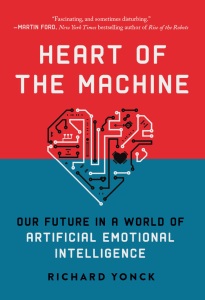
 In episode #11, futurist Ian Pearson spoke to his assertion that artificial intelligence will create jobs. One of the main reasons for this, he believes, will be the need to provide an emotional human interface between A.I. and its intended beneficiaries, be they patients, consumers, or business clients. But the field of affective computing is rapidly developing artificial intelligence that can read and respond to human emotion. They are systems with emotional intelligence. In episode #12, I talk with author Richard Yonck. His new book, Heart of the Machine, provides a comprehensive overview of the current state of development in emotional A.I., while providing cogent scenarios projecting where it might lead us in the future.


 One of the hottest topics in foresight today is artificial intelligence. And while many of the most visible forward thinkers have been stressing over potential existential threats to all of humanity, there is a more mundane threat to all of us. That would be our world of work. As automation on the assembly line replaces more and more unskilled labor jobs, there lies the looming threat of artificial intelligence taking on skilled, professional jobs. Will A.I. kill your job? Create you a new one? Both? Neither? While the media is full of pessimism on this account, at least one prominent futurist is cautiously optimistic. Author, speaker and blogger Ian Pearson, of Futurizon thinks that, at least in the short term, A.I. will create more jobs than it kills. I talk to him about these views, as well as the longer range existential effects of A.I., in this week’s Seeking Delphi Podcast.


 Seeking Delphi™