Unknown's avatar

Short Fiction: A Life Pod at Riverton

Here is a fascinating question for those who fear the apocalypse. Can there be a post-collapse world that might not be so bad? In this short piece of fiction, my University of Houston foresight colleague, Eric Kingsbury, suggests a future transformation that might not be so bad. It’s re-blogged from his site, http://www.kiteba.com

Eric Kingsbury's avatarKiteba: A Futurist Blog and Resource

Speculative fiction has always been a great way to imagine the future. The following is a short climate-related piece I wrote.

A Life Pod at Riverton

“When we look at biological analogues,” Jane began, lifting the cover off the evap system and dropping to one knee, “we see the many ways in which large organisms are vulnerable when climate push comes to climate shove.”

The sun hovered in an infinite sky, bright, blanching out any atmospheric color. It was spring, and the air was warming, with a sweet sugar breeze.

Jane lifted a hand to shadow her eyes.

“Elephants, lions, cows, all the big mammals,” she said, then gestured in the direction of several grassy mounds that rose from the prairie. “Too big, too slow, too pack-oriented. Vulnerable.”

Then, she reached into the evap unit and pulled out a length of rotten rubber hose.

“So too all the networks dependent on…

View original post 652 more words

Unknown's avatar

The Future This Week, March 12, 2017

“You affect the world by what you browse.”–Tim Berners-Lee

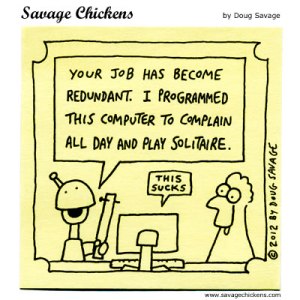
Ah, our automated future. http://www.savagechickens.com

The Tim Berners-Lee quote above is a sort of digital version of “you are what you eat.”  Perhaps, today, we are what we browse.  But what we browse is of deep concern.  Can we keep it private? Can others, particularly government, abuse our rights and destroy our privacy with what they know about our lives online?  That’s just one of the technology issues in The Future This Week.

Digital Technology–World Wide Web inventor, Tim Berners-Lee, had some chilling words about his digital offspring on its 28th birthday.  Speaking at the South by Southwest conference in Austin, Texas, he warned the web is in peril due to three troublesome trends.  Privacy of personal data, in the wake of the Wikileaks revelation of massive CIA cyber-spying, fake news that spreads like wildfire, and unregulated political advertising.  I welcome a discussion on these issues in the comments section below.

Speaking at Google’s Cloud Next conference, Alphabet CEO Eric Schmidt predicted that big data will become so important that nations will fight over it. “He who has the data can do the analytics and algorithms,” he said.  You can see his full speech on the Business Insider link here.

Digital Entertainment–Several sources reported that Netflix is delving into interactive story telling that enables the viewer to chose from diverging story lines.  This would represent a kind of digital video version of the Chose-Your-Own-Adventure kid-lit novels that were popular in the 1980’s. Actors would film multiple variations of story lines and viewers would be allowed to chose the direction of the story at various points.  The first series may roll out later this year.

Renewable Energy–Those hydrogen fuel-cell-powered vehicles discussed in episode #3 of the Seeking Delphi podcast may be one step closer to reality.  New work revealed this week by the energy department’s Lawrence Berkeley Laboratory.  A big challenge is the extrication of  hydrogen from water., which, in itself, is an energy intensive undertaking.  The process Berkeley lab has been working on involves using special catalyst materials called photo-anodes to drive distillation of Hydrogen from water using sunlight.   Their scientists have identified 12 newphoto-anode substances in the past two years, more than doubling the previously known count.

Biotechnology–CRISPR gene editing pioneer, Jennifer Doudna, laid out her vision for the technology.  Speaking at the same South by Southwest conference that hosted Tim Berners-Lee, she focused primarily on the potential for eradicating genetic diseases.  Meanwhile, a Chinese team released results of the first CRISPR trials in healthy, viable embryos, reporting that they were able to correct genetic mutations in some of them.

Global Economy–A new report issued by The Brookings Institute projects a global increase in the middle class of 2.2 billion people by 2030.  The report also sees 88 per cent of this growth coming from Asia.

Hawking

Existential Technology Risks–Almost on cue for the most recent Seeking Delphi  episode,  physicist Stephen Hawking warned that establishment of a global government may be the only way to keep our technologies from destroying us.  He acknowledged that a world government could become a problem in itself–particularly a tyrannical one–but stated strongly that we need a means to identify threats, and act quickly to counter them in a unified manner.

A reminder that the Seeking Delphi™ podcast is available on iTunes, and has a channel on YouTube.  You can also follow us on Facebook.

Unknown's avatar

Podcast #6, Technology: The Good, The Bad and The Existential.

“We’ve arranged a civilization in which most crucial elements profoundly depend on science and technology.”–Carl Sagan

Here Be Dragons, Science Technology and The Future of Humanity
by Olle Häggström

Technology.  We certainly do depend on it.   It does great things for us, but it also can annoy us and, indeed, has the potential to do us outright harm.  In this episode of Seeking Delphi, I talk to author Olle Häggström about some of the existential risks that technology may pose to humanity.  His book, Here Be Dragons, is a thorough examination of a wide ranging inventory of potential dangers, from the ones we currently know and worry about (climate change, nuclear war), to the ones that yet might be (bio terrorism, nanotechnology, artificial intelligence) ,and the ones Hollywood fantasizes about (alien invasion).  Olle is a professor of mathematics at Chalmers University of Technology in Göteborg, Sweden.  I called him there to conduct the interview for this episode.

Links to relevant stories appear after the audio file and embedded YouTube video below.  A reminder that Seeking Delphi is available on iTunes, and has a channel on YouTube.  You can also follow us on Facebook.


Episode #6, Technology: The Good, The Bad, and The Existential  25:41

(YouTube slideshow)

Bigelow Aerospace plans to orbit lunar space station by 2020.

Blue Origin planning a lunar delivery service, a la Amazon.

Lawrence Berkeley lab doubles the number of materials potentially useful for solar fuels

Volkswagon unveils Sedric, its entry into the self-driving vehicle market.  (It looks like a breadbox on wheels.)

Subscribe to Seeking Delphi on iTunes 

Subscribe on YouTube

Follow Seeking Delphi on Facebook @SeekingDelphi

Follow me on twitter @MarkSackler

Unknown's avatar

The Future This Week, March 5, 2017

“If you want a nation to have space exploration ambitions, you’ve got to send humans.”-Neil deGrasse Tyson

Neil might have added, “or have profit motives.”  The news about commercial space exploration is almost nonstop these days.  Here’s what’s been happening in the past week.

Commercial space ventures–

In more down-to-earth news:


Unknown's avatar

Podcast #5: Teaching and Learning the Future

“Tell me and I will forget, teach me and I will remember, involve me and I will learn.”–Benjamin Franklin

“Those who can’t do, teach.  Those who can’t teach, teach gym.”–Woody Allen

teach-the-future-logoMy apologies to all you educators out there.  I just had to get that Woody Allen line in.  It makes sense, though, that teaching something as fluid, changing and uncertain as the future requires creative tools to involve the student and develop the appropriate mindset.  In episode #5 I talk with two individuals who are taking different approaches to the task.

Peter Bishop

Peter Bishop

The first interview is with career futurist educator, Peter Bishop, founder of Teach the Future.™  His aim is nothing less than to make future-think modules a standard in education.  I then talk with game developer Robert Mattox about his old school approach to involvement–a board game.  Appropriate links to all the subjects in this program can be found below the audio and YouTube files that follow.  A reminder that Seeking Delphi is available on iTunes, and has a channel on YouTube.  You can also follow us on Facebook.


Robert Mattox

Robert Mattox

Podcast #5: Teaching And Learning The Future, 26:50

Hope City

Hope City


Teach The Future

Hope City

Smart robots will outnumber people by 2050

McDonald’s to kill the drive-through with mobile ordering and curbside delivery.

SpaceX plans lunar tourism next year.


Subscribe to Seeking Delphi on iTunes 

Subscribe on YouTube

Follow Seeking Delphi on Facebook @SeekingDelphi

Follow me on twitter @MarkSackler

Unknown's avatar

The Future This Week, February 26, 2017

“I would like to die on Mars.  Just not on impact.”–Elon Musk

cropped-mars.jpg

Surprisingly, there is no new Elon Musk news this week.  In an even bigger surprise, Mars was in the news, but without Elon Musk–at least not by name.

Space Exploration–

  • The United Arab Emirates unveiled a 100-year goal to colonize Mars with 600,000 people.  The public announcement of the Mars 2017 Project came at a World Government meeting held in Dubai and was made in a speech by sheikh Mohammed bin Rashid, in which he emphasized his nations long-term commitment to space exploration.


  • In plans that are much nearer in time and space, the Russian space agency Energia announced plans to send tourists to the moon by 2022.  They say they will sell nine places on its Soyuz space capsule, as soon as this spring, for flights as soon as 2022.  The craft that will loop around the moon before heading to the International Space Station.  This represents an aggressive upgrade from its previous plan,  originally projected to be launched in the early 2030’s.  No indication of price or selection process for tourists was given.  Start saving your Aeroflot frequent flyer miles now.


  • SpaceX (okay, that is an Elon Musk story, at least indirectly) announced a new target date of 2020 for landing a robotic probe on Mars.  This represents a setback from the original target of 2018.

Biotech–

  • Market Research Future released a study projecting that the global bioprinting market, estimated to have been worth $570 million in 2015, will grow at a compound annual rate of 25-27% through 2022.  At present, they estimate that North America holds a 40% share of this market.


Robotics–

  • The private sector is not the only place where workers are being replaced by AI and machines.  The San Diego Union-Tribune reports that the U.S. military is in the process of developing and deploying automation to streamline its support operations and even reduce personnel on the front lines.  Some of the concepts include driverless combat vehicles and robotic frogmen.


Structural engineers may soon be able to determine if London Bridge is falling down--without actually visiting it.

Structural engineers may soon be able to determine if London Bridge is falling down–without actually visiting it.

Virtual Reality–

  • World Architecture News reported that a joint project of Microsoft and the University of Cambridge aims to enable structural engineers to inspect bridges using the Hololens virtual reality headset, rather than traveling in person to the sites.  This would be accomplished by creating a combining composite of photos taken locally by non-experts, allowing expert engineers to zoom in and out and take a virtual walk-around of a structure. The idea is to save the time and cost of travel.