Unknown's avatar

Podcast #10: Lights! Action! Camera! The Future of Cinema and Digital Entertainment

“Movies are a fad. Audiences really want to see live actors on a stage.”–Charlie Chaplin

How wrong could Charlie Chaplin have been, over 100 years ago, when he made that statement?  He was in the nascent stages of a film career that would make him one of the most iconic figures in the history of cinematic arts.  Yet, even in the middle of a major communication revolution, he couldn’t see the forest for the trees.   Today, technology changes that used to take decades, take barely a few months.  Can we be any better than Charlie Chaplin at foreseeing which of today’s new media technologies will be the long term winners?  For that matter, will anything last long enough to be considered “long term?”  In Episode #10 of Seeking Delphi, I talk to author and filmmaker Steven D. Katz.  He was writing about technologies like CGI and digital media for Millimeter Magazine before most others in the industry were even noticing them.  Steve acknowledges that the traditional large-screen movie house will have to continue to up its game to compete with home technologies and distribution options that keep on getting better.

Links to relevant stories appear after the audio file and embedded YouTube video below.  A reminder that Seeking Delphi is available on iTunes, and has a channel on YouTube.  You can also follow us on Facebook.

Film Directing Shot By Shot
by Steven D. Katz
One of the best-selling film making textbooks of all time.

Episode #10: The Future of Cinema and Digital Entertainment


(YouTube slide show)


Books by Steven D. Katz

Hyperloop One finished its test track, and narrowed down the candidates for the first two systems to be built in the U.S.

Boeing and Jet Blue have backed a venture aiming to deliver hybrid electric commuter jets by the early 2020s

The U.S Air Force is developing hyper-sonic attack drones for the 2040’s.

No, I didn’t make this up.  A Chinese engineer married his robot wife!

Subscribe to Seeking Delphi on iTunes 

Subscribe on YouTube

Follow Seeking Delphi on Facebook @SeekingDelphi

Follow me on twitter @MarkSackler

Unknown's avatar

The Future This Week, April 2, 2017: Robot Job Apocalypse?

“The danger of the past was that men became slaves. The danger of the future is that men may become robots.”–Erich Fromm

You’re fired!

Today’s lead story brings to mind a classic gag from Woody Allen’s early stand-up comic days.  He told the story of how his father came home from work one day to report that he had been laid off from his factory job; he was replaced by a 50-dollar part on the assembly line.  The sad thing was, his mother immediately ran out and bought one of those parts.

The notion that a manufacturing plant  could be comprised of 3D printers run and maintained by robots is mind boggling.  So who maintains the maintenance robots?  Maintenance maintenance robots?  And who maintains the maintenance maintenance robots….?

3D Printing/Automation–

Yes, Voodoo manufacturing has created the world’s first robot-run 3D printing plant.   It allows the humans to concentrate on the creative work while the robots do the menial work, 24/7.  So what happens when A.I. starts doing the creative work?

Writing in the futures blog on Futurizon,  Ian Pearson, Ph.D., takes the position that A.I. will actually create jobs, not take them.  Dr. Pearson will be my guest on the Seeking Delphi podcast, the week of April 10.


Miranda. Maybe this is where all those lost socks went?

Space/NASA–NASA astronauts made a big booboo when they lost an important part of the International Space Station during a spacewalk earlier this week.   One of four pieces of cloth shielding designed to protect the station from impacts by small bits of orbiting  space junk, broke free and floated away.  The astronauts were able to make the other three pieces make do.  That’s a good thing.  For all we know, the interplanetary lost and found could be on Miranda.

Next Big Future reports that there is a push within the Chinese government to triple spending on space science over the next several years.  It’s still far less than NASA spends, though. Projections through the year 2030 are provided.

Digital Media–Business Insider issued a report, along with a free slide presentation, on the future of TV and the digital media that is rapidly replacing it.  Most notable is a forecast that fully 75% of all mobile data will be video by 2022.  My guest next week will be filmmaker and author Steven Katz  to discuss the future of  cinema and the digital video entertainment it is competing with.

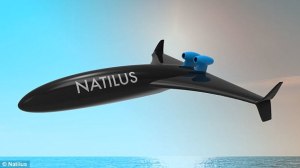
Cargo drone or killer whale?

Aviation/Drones– An automated  amphibious cargo drones the size of a Boeing 777 could take to the skies by 2020.  Daily Mail reports that the California company building them is about 70% complete on the first test model.  The final production model will have a carrying capacity of 200,000 pounds.

Biotech/Anti-Aging–PureTech Health has licensed a possible anti-aging compound from NovartisMIT Technology Review reported that Boston-based startup company .  The drug, everolimus has been shown in clinical trials to increase effectiveness of flu vaccines in elderly patients, suggesting that it effectively makes immune systems younger.  The substance is related to rapamycin, which has previously been shown to increase average life span in mice by as much as 25%.

A reminder that the Seeking Delphi™ podcast is available on iTunes, and has a channel on YouTube.  You can also follow us on Facebook.

Unknown's avatar

Podcast #9, Ethics and Emerging Technologies

All attempts to adapt our ethical code to our situation in the technological age have failed.–Max Born 

When thinking about the future of technology, many envision one extreme or the other.  Apocalyptic collapse, or Utopian delight.  There is a broad in between, however, filled with ethical as well as existential conundrums.  In this episode of Seeking Delphi, I talk with James J. Hughes, director of The Institute for Ethics and Emerging Technologies about a wide range of issues.  These include not just the ethics of if, how, and when to proceed with certain technologies, but the ethics of public policy in dealing with the potentially disruptive social and economic changes they trigger.  The future is not black and white–in case you hadn’t noticed–but infinite shades of gray. It’s also clouded by the rise of the right and the Trump administration.

Links to relevant stories appear after the audio file and embedded YouTube video below.  A reminder that Seeking Delphi is available on iTunes, and has a channel on YouTube.  You can also follow us on Facebook.


Episode #9: Ethics and Emerging Technology


(YouTube slideshow)


James Hughes bio

Harvard scientists to launch ambitious geoengineering experiment

World Future Society 2017  conference in Edinburgh, Scotland, Oct 12-14 (details soon).

Elon Musk launches venture to link brains directly to computers

Subscribe to Seeking Delphi on iTunes 

Subscribe on YouTube

Follow Seeking Delphi on Facebook @SeekingDelphi

Follow me on twitter @MarkSackler

Unknown's avatar

Podcast #7, The 3D Printing Explosion: Cars, Homes, Even Human Bodies!

“Whatever good things we build end up building us.”– Jim Rohn

I can’t say for sure if the quote above was intended literally, but it is now becoming literally true.  The applications of additive manufacturing–better known as 3D printing–are expanding to include food, body parts, cars, and even entire buildings.  In this episode of the Seeking Delphi™  podcast, I talk with one of the gurus of this technology, Dr. Paul Tinari, of JOOM3D.com .  He’s working on a project the scope of which would have been unimaginable just a few years ago.

Links to relevant stories appear after the audio file and embedded YouTube video below.  A reminder that Seeking Delphi is available on iTunes, and has a channel on YouTube.  You can also follow us on Facebook.


Episode #7, Additive Manufacturing: We Are What We Print 21:07


(YouTube slideshow)


Paul Tinari Bio

Russian space agency recruiting cosmonauts for 2031 lunar landing mission

Ray Kurzweil revises his singularity forecast to 2029

The U.S. military seeks to “understand” its autonomous machines

Subscribe to Seeking Delphi on iTunes 

Subscribe on YouTube

Follow Seeking Delphi on Facebook @SeekingDelphi

Follow me on twitter @MarkSackler

Unknown's avatar

Podcast #6, Technology: The Good, The Bad and The Existential.

“We’ve arranged a civilization in which most crucial elements profoundly depend on science and technology.”–Carl Sagan

Here Be Dragons, Science Technology and The Future of Humanity
by Olle Häggström

Technology.  We certainly do depend on it.   It does great things for us, but it also can annoy us and, indeed, has the potential to do us outright harm.  In this episode of Seeking Delphi, I talk to author Olle Häggström about some of the existential risks that technology may pose to humanity.  His book, Here Be Dragons, is a thorough examination of a wide ranging inventory of potential dangers, from the ones we currently know and worry about (climate change, nuclear war), to the ones that yet might be (bio terrorism, nanotechnology, artificial intelligence) ,and the ones Hollywood fantasizes about (alien invasion).  Olle is a professor of mathematics at Chalmers University of Technology in Göteborg, Sweden.  I called him there to conduct the interview for this episode.

Links to relevant stories appear after the audio file and embedded YouTube video below.  A reminder that Seeking Delphi is available on iTunes, and has a channel on YouTube.  You can also follow us on Facebook.


Episode #6, Technology: The Good, The Bad, and The Existential  25:41

(YouTube slideshow)

Bigelow Aerospace plans to orbit lunar space station by 2020.

Blue Origin planning a lunar delivery service, a la Amazon.

Lawrence Berkeley lab doubles the number of materials potentially useful for solar fuels

Volkswagon unveils Sedric, its entry into the self-driving vehicle market.  (It looks like a breadbox on wheels.)

Subscribe to Seeking Delphi on iTunes 

Subscribe on YouTube

Follow Seeking Delphi on Facebook @SeekingDelphi

Follow me on twitter @MarkSackler
Unknown's avatar

The Future This Week, February 26, 2017

“I would like to die on Mars.  Just not on impact.”–Elon Musk

cropped-mars.jpg

Surprisingly, there is no new Elon Musk news this week.  In an even bigger surprise, Mars was in the news, but without Elon Musk–at least not by name.

Space Exploration–

  • The United Arab Emirates unveiled a 100-year goal to colonize Mars with 600,000 people.  The public announcement of the Mars 2017 Project came at a World Government meeting held in Dubai and was made in a speech by sheikh Mohammed bin Rashid, in which he emphasized his nations long-term commitment to space exploration.


  • In plans that are much nearer in time and space, the Russian space agency Energia announced plans to send tourists to the moon by 2022.  They say they will sell nine places on its Soyuz space capsule, as soon as this spring, for flights as soon as 2022.  The craft that will loop around the moon before heading to the International Space Station.  This represents an aggressive upgrade from its previous plan,  originally projected to be launched in the early 2030’s.  No indication of price or selection process for tourists was given.  Start saving your Aeroflot frequent flyer miles now.


  • SpaceX (okay, that is an Elon Musk story, at least indirectly) announced a new target date of 2020 for landing a robotic probe on Mars.  This represents a setback from the original target of 2018.

Biotech–

  • Market Research Future released a study projecting that the global bioprinting market, estimated to have been worth $570 million in 2015, will grow at a compound annual rate of 25-27% through 2022.  At present, they estimate that North America holds a 40% share of this market.


Robotics–

  • The private sector is not the only place where workers are being replaced by AI and machines.  The San Diego Union-Tribune reports that the U.S. military is in the process of developing and deploying automation to streamline its support operations and even reduce personnel on the front lines.  Some of the concepts include driverless combat vehicles and robotic frogmen.


Structural engineers may soon be able to determine if London Bridge is falling down--without actually visiting it.

Structural engineers may soon be able to determine if London Bridge is falling down–without actually visiting it.

Virtual Reality–

  • World Architecture News reported that a joint project of Microsoft and the University of Cambridge aims to enable structural engineers to inspect bridges using the Hololens virtual reality headset, rather than traveling in person to the sites.  This would be accomplished by creating a combining composite of photos taken locally by non-experts, allowing expert engineers to zoom in and out and take a virtual walk-around of a structure. The idea is to save the time and cost of travel.