Unknown's avatar

The Future This Week: November 28, 2017

“Always make the audience suffer as much as possible.”–Alfred Hitchcock

It seems movie theater owners are taking Hitchcock quite literally.  At our first break from home binge watching in almost a year, my wife and I went to a local cinema. We arrived right on the dot at the advertised starting time of the movie, and immediately suffered through 20 minutes of commercials–exactly what we get away from by watching Amazon and Netflix and premium cable channels.  I just love paying to binge watch commercials.

 While you’re reading about all this week’s future-related  news, don’t forget that you can subscribe to Seeking Delphi™ podcasts on iTunes or PlayerFM, and you can also follow us on Twitter and Facebook 

Digital entertainmentAmazon, Apple, and Netflix  are expected to be spending nearly $20 Billion, combined, on digital content by 2022.  Take that, Bollywood.

The Venture Reality Fund reports that Hollywood’s investment in AR and VR is booming.  Overall, AR/VR investment in the second half of this year is seen as rising by $2.3 billion, or 79 per cent, over the same period a year ago.  Oh boy, even those insufferable commercials will be enhanced.

The worm turns–on mars.

Space Travel/Colonization–What’s better than pigs in space?  How about worms on Mars?  A recent study by researchers at Wageningen University found that earth worms can grow and reproduce in Martian-like soil. It’s part of a study to see if food plants can grow in the same compound, to support potential colonization.

–Woody Allen once said, “man can’t live on bread alone; often there must be a beverage.”  Anheiser-Busch is taking that literally by sending beer into space.  A Dec. 4 SpaceX launch will send beer making ingredients to the international space station, a very early step toward sending it to Mars with the first colonists.  Talk about opening new markets.

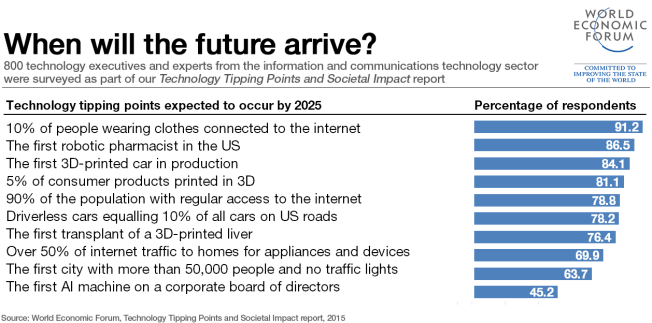
Future Life/2030 Forecasts–A new report from The World Economic Forum paints a heady picture of life in the year 2030.  Genetically engineered pets…smart toilets…internet connected clothes…wow, I can hardly wait.
 

A similar study, reported in Forbes, focuses more on how we will change as humans by 2030. It’s not about augmented reality, it’s about augmented us.

Transportation/Sustainable Energy–Hydrogen powered trains will be coming to Germany by 2021.  The technology is being built by French concern, Alstom.

Robotics/AI–China announced plans to open a fully automated police station, sans humans.  The facility will deal primarily with driving -related issues, making it more like a western motor vehicle department facility.  It’s all in line with China’s stated goal of being world leader in artificial intelligence by 203o.

A reminder that the Seeking Delphi™ podcast is available on iTunesPlayerFM, blubrry , and has a channel on YouTube.  You can also follow us on Facebook.

Unknown's avatar

The Future This Week: November 20, 2017

 “There are nights when the wolves are silent and only the moon howls.” –George Carlin

Ah, the moon; so close, and yet so far away.  Has it really been almost fifty years since Neil Armstrong took his one small step for man?  Now, finally, the race is on to go back to our nearby celestial neighbor.  But in 1969, the only motivation was to win a race that was instigated by the cold war.  Now there is different driver in play.  It’s money;  many of the new players, in what is now a multi-way competition, are commercial ventures.

 While you’re reading about all this week’s future-related  news, don’t forget that you can subscribe to Seeking Delphi™ podcasts on iTunes or PlayerFM, and you can also follow us on Twitter and Facebook 

Space/Lunar explorationMoon Express has unveiled its lunar rover that’s due for a 2019 launch.  Described as an R2D2 lookalike, it would be the first commercial launch beyond earth orbit. The $20 million lunar X-Prize is hanging in the balance.

Yoda would be proud

China has announced plans to catch up to the US in space rocketry by the early 2020’s,  and a longer term goal of developing nuclear powered space vehicles by 2045.

Next big future reports on the possible development of what’s being called an interlunar photonic railway.  It’s based on the the laser powered space sails being planned by Breakthrough Starshot.

Electric Vehicles–Tesla unveiled two new ambitious vehicles, slated to begin production in 2019.  Its big-rig truck has a projected single-charge range of 500 miles and acceleration capabilities far better than diesel powered semis.  The roadster will boast a 620-mile range and a 260 mph top speed.  The price for these indulgences?  I’m not asking; i know I can’t afford either one.

Zoom Zoom

–Elon Musk may be the pioneer in all-electric vehicles, but he’s certainly not alone.  Volkswagon plans to invest an immodest $40 Billion on electric car technology through 2022,  and Toyota is targeting 2020 for its launch of an EV in China.

Senescence/Anti-aging research–Harvard professor and serial biotech entrepreneur Dr. George Church is moving headlong towards enabling human aging reversal.  His Rejuvenate Bio firm plans to test an age reversal therapy in dogs in 2019, and if successful, followed by human trials in 2022.

Scientists at Northwestern University say they have found what may be the first anti-aging genetic mutation.  The genetic anomaly was found in a small Amish community in Indiana.  Individuals who possess the mutation experience longer than average lifespans.

A reminder that the Seeking Delphi™ podcast is available on iTunesPlayerFM, blubrry , and has a channel on YouTube.  You can also follow us on Facebook.

Unknown's avatar

Podcast #17: IEEE and Ethical Considerations In Artificial Intelligence and Autonomous Systems

“The real question is, when will we draft an artificial intelligence bill of rights? What will that consist of? And who will get to decide that?” —Gray Scott


Gray Scott’s comment aside, there are more pressing issues than a robot bill of rights.  Artificial intelligence development is progressing at an ever accelerating rate, and bringing with it questions of privacy, unemployment, and potential malevolent uses of the technology.  In this edition of the Seeking Delphi™ podcast, I talk with author John C. Havens about these issues.   He’s executive director of the IEEE Global Initiative for Ethical Considerations In Artificial Intelligence and Autonomous Systems.

Links to relevant stories appear after the audio file and embedded YouTube video below.  A reminder that Seeking Delphi is available on iTunes, PlayerFM, and has a channel on YouTube.  You can also follow us on Facebook

Follow me on twitter @MarkSackler


Episode #17: Ethical Considerations in Artificial Intelligence and Autonomous Systems with John C. Havens

YouTube slide show of Episode #17


John C. Havens biography

IEEE Global Initiative for Ethical Considerations in Artificial Intelligence and Autonomous Systems

Heartificial Intelligence on Amazon

Dubai appoints state minister for A.I.

India appoints experts to advise government on A.I.

Tesla announces addition of new autopilot features in the near future

Eric Schmidt warns U.S. on China’s impending lead in A.I.

Saudi Arabia’s newest citizen, Sofia


Subscribe to Seeking Delphi™ on iTunes 

Subscribe to Seeking Delphi™ on PlayerFM

Subscribe on YouTube

Follow Seeking Delphi™ on Facebook @SeekingDelphi

Follow me on twitter @MarkSackler

Unknown's avatar

The Future This Week: October 31, 2017

“Aging is mostly the failure to repair”– Gregory Benford

“Age is inevitable; aging isn’t”–Marv Levy

Even as lifestyle issues like smoking, obesity, distracted driving and drug overdoses have of late limited life expectancy gains in the west, there continue to be breakthroughs in anti-aging research at breathtaking pace.  At some point–maybe soon–we may experience a period of anti-aging therapy deployment such that average life expectancy increases by one or more years every year. How long will we live, then?  And the bigger question is: what will be the implications for civilization and the earth as a whole?

 While you’re reading about all this week’s future-related  news, don’t forget that you can subscribe to Seeking Delphi™ podcasts on iTunes or PlayerFM, and you can also follow us on Twitter and Facebook 

Anti-aging/Longevity research–Virtual biotech company, Youthereum, believes they can extend healthy human lifespan by 30% using epigenetics.  The idea of such an approach as  has been around for decades; they believe they are in striking range of achieving it.  The unconventional part of the plan is not the science, it’s financing the research, which they hope to accomplish through an ICO (Initial Coin Offering) of a new cryptocurrency.

Two University of Arizona scientists have published a paper on the mathematics of aging, purporting to prove that immortality is impossible.  That sounds suspiciously like the scientist who published a paper supposedly proving that space travel was impossible, just a few months before the launch of the first Sputnik.

Food– Food distribution giant, Cargill, Inc., has joined the likes of Bill Gates and Richard Branson with investments in Memphis Meats.  The San Francisco-based (not Tennessee) company says its products–lab grown beef, chicken and duck–will be in stores by 2021 and will eventually cost as little as $1 a pound.  The products use real animal cells, but obviate the need to raise and kill live animals.

Space Launch and Propulsion–Positron Dynamics is projecting the potential launch of an anti-matter propelled cubesat by as early as sometime next year.  It further forecasts that a Mars-bound anti-matter powered rocket could be launched by the 2030’s.

–Meanwhile, Elon Musk’s SpaceX continues to make progress towards lowering the cost of space launches.  This past week, it conducted its fifteenth consecutive successful launch and first stage landing of the reusable Falcon 9 rocket.

China/Economic Development–The New York Times reports that Chinese president Xi Jinping wants to fully eliminate poverty in his country by 2020.   It’s all part of the larger Xi plan which outlines many of the country’s goals, including those in healthcare, AI, and the sharing economy, through 2050.

A reminder that the Seeking Delphi™ podcast is available on iTunesPlayerFM, blubrry , and has a channel on YouTube.  You can also follow us on Facebook.

Unknown's avatar

The Future This Week: October 23, 2017

 “I think we are at the dawn of a new era in commercial space exploration.”–Elon Musk

Nothing accelerates technological development like competition. It was the competition between the US and the Soviet Union that put a man on the moon in 1969, decades sooner than it would otherwise have occurred.  The finish line of that race ended the competition, and we haven’t gone back since.  But a new competition, multi-faceted and far more diverse, has begun.  The commercial development of space figures to re-accelerate our push into the final frontier. If you’re a fan of space exploration and exploitation, stay tuned, the next few years are going to be exciting.

 While you’re reading about all this week’s future-related  news, don’t forget that you can subscribe to Seeking Delphi™ podcasts on iTunes or PlayerFM, and you can also follow us on Twitter and Facebook 

Fly me to the moon…in 2022

Space exploration/exploitation/tourismUnited Launch  Alliance and Bigelow Aerospace have announced a joint venture to place a habitat in lunar orbit by 2022.  While they describe fully how they intend to get it there, they don’t yet say who will inhabit it or what it might be used for.  Anyone want to rent a lunar-orbiting apartment?

Richard Branson says his Virgin Galactic commercial space venture will launch its first astronauts into space in about 4 months.  He also says his program will do more for humanity than Elon Musk’s ambitious SpaceX plans to colonize Mars.  Branson vs. Musk is not exactly USA vs. USSR; in fact,  it might actually be more sustainable.

–Branson and Musk aren’t the only billionaire-sized egos in space.  Jeff Bezos’s Blue Origin announced  a breakthrough that brings it one step closer to launching sub-orbital space tourism flights by 2019. They successfully test fired their new BE-4 rocket engine.

While NASA progresses at a snails pace in returning US astronauts to the moon, it’s ramping up the effort to detect nearby, habitable earth-like planets.  How they will ever get us there is another question, altogether.

Artificial Intelligence–Elon Musk says that the AI in a Tesla will soon be able to predict your destination and bring you there without asking. That’s good; half the time I have no idea where I’m going.  Seriously, though, that’s amazing–and kind of creepy at the same time.

The New York Times reports that tech giants are paying big bucks for the services of Artificial Intelligence experts.  The deals they offer them often include signing bonuses and multi-year contracts, sometimes resembling those offered to professional athletes.

–Dubai and India are both jumping on the A.I. bandwagon, as far as government monitoring and regulation is concerned.  Dubai is appointing a minister of artificial intelligence, while India is establishing an expert panel to advise government on policy.

Biotechnology–An Italian neurosurgeon says he will conduct the world’s first full head transplant in December of this year.  And you were skeptical of self-driving cars.

A reminder that the Seeking Delphi™ podcast is available on iTunesPlayerFM, blubrry , and has a channel on YouTube.  You can also follow us on Facebook.

Unknown's avatar

Podcast #16: Options for Future Human Evolution

“If evolution really works, how come mothers only have two hands?”–Milton Berle

“There are no shortcuts in evolution.”–Louis Brandeis

Milton Berle was simply funny;   Louis Brandeis is about to be proven  wrong.  Humanity is on the cusp of a new era, full of promise and peril.  We are on the verge of directing our own evolution, and when that comes, it will come at a breakneck pace.  Breakthroughs in biotech and info-tech are rapidly hurtling us towards an age of self-directed evolution.  It will be change by choice, not by chance.  What are those choices, and how will we deal with them? How will it change what it means to be human?  That is the subject of a forthcoming book by futurist Linda Groff,  who joins me as my guest on this episode of Seeking Delphi.™

Links to relevant stories appear after the audio file and embedded YouTube video below.  A reminder that Seeking Delphi is available on iTunes, PlayerFM, and has a channel on YouTube.  You can also follow us on Facebook.


Episode#16: Options For Future Human Evolution


Linda Groff, bio.

Global Options and Evolutionary Futures

News Story Links

Kalashnikov hover bike

Renault hover car design contest winner

Senate subcommittee unanimously approves self-driving car legislation 

Sex robot damaged beyond repair at arts festival in Austria


Subscribe to Seeking Delphi™ on iTunes 

Subscribe to Seeking Delphi™ on PlayerFM

Subscribe on YouTube

Follow Seeking Delphi™ on Facebook @SeekingDelphi

Follow me on twitter @MarkSackler